AI customer service for Shopify means an AI agent that reads your catalog and live order data, answers customers on the channels they already use, around the clock, and hands off to your team in the helpdesk built into it. Order tracking alone is roughly half of all customer queries across the stores we run (Support Fabric data, October 2026).
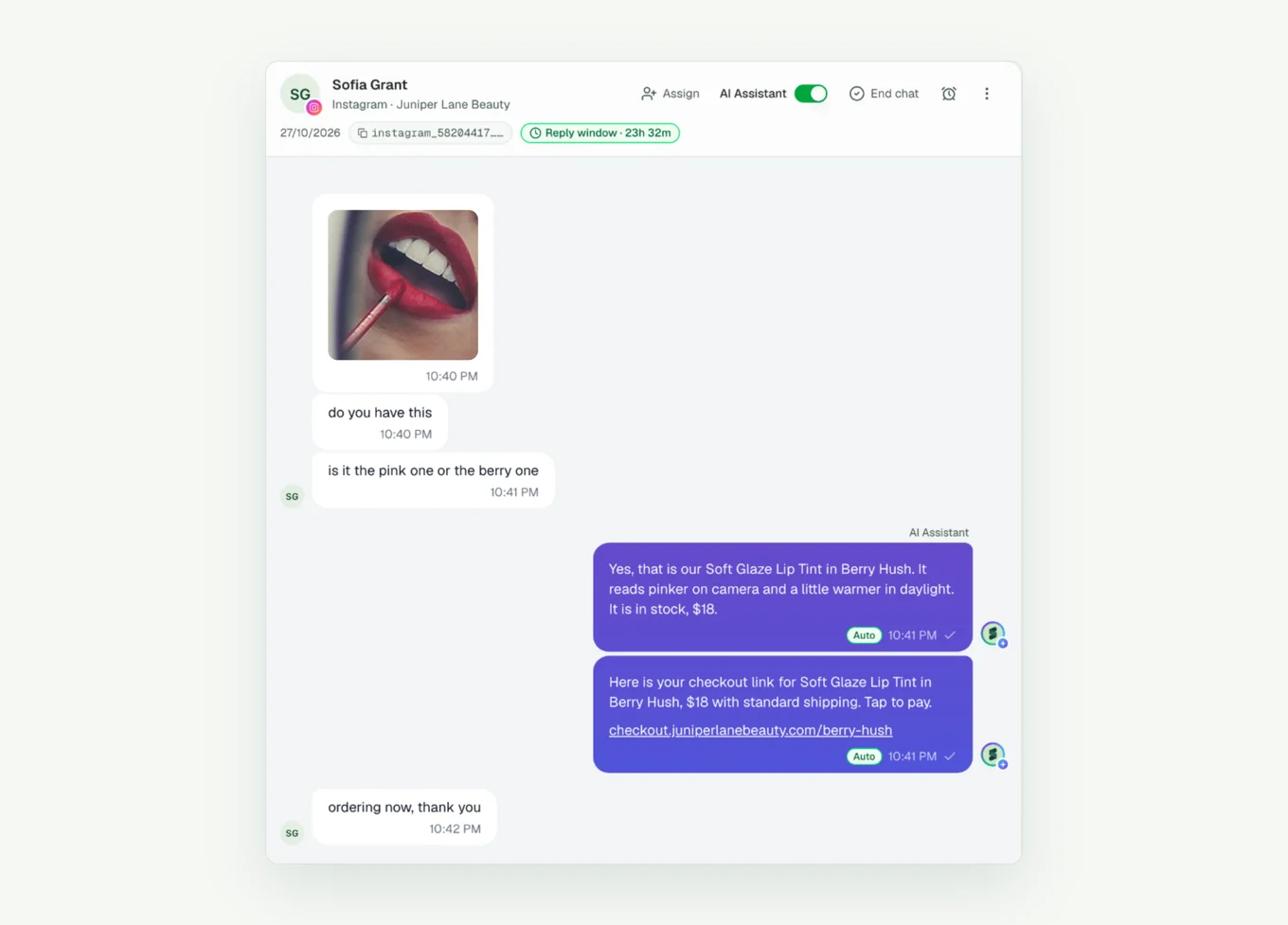
Here is what the other half can look like, with a demo store standing in for a real one. Juniper Lane Beauty gets an Instagram DM at 10:40 PM: a blurry screenshot of a lip tint from a creator's video, then "do you have this", then "is it the pink one or the berry one". At most stores this sits until morning. An AI agent trained on the catalog replies in seconds: it matches the screenshot to the product, names the shade and drops a checkout link in the thread.
Key facts
- Support Fabric answers on WhatsApp, Instagram DMs, Facebook Messenger, website chat and email, 24/7, with a helpdesk built in (November 2026).
- Support Fabric goes live 48 hours after onboarding, and the client installs an app instead of giving store admin access (November 2026).
- One Support Fabric plan covers the build, the training, the go-live and running the agent, as of November 2026, with details on the pricing page.
- Support Fabric passes AI usage through at cost with no markup, and a conversation costs 2 to 4 cents in AI usage (November 2026).
- One men's grooming brand Support Fabric runs converts 1 in 13 chats into an order (Support Fabric data, October 2026).
What an AI agent for Shopify means
Search "AI agent for Shopify" and you get three different products. The first works for you in the back office: Sidekick, Shopify's AI commerce assistant, runs inside your Shopify admin and helps with jobs like editing orders and writing product descriptions. The second shops for your customers: Shopify's Agentic Storefronts channel puts your products on AI shopping platforms, where an agent helps a shopper discover, compare and buy inside a conversation. The third talks to your customers when they message you, and that is the one this page covers.
A support agent answers product, sizing and order questions, sells in the thread and hands the rest to your team. Shopify's own is the opt-in AI agent in Shopify Inbox, covered next. Support Fabric's agent does this on WhatsApp, Instagram DMs, Messenger, website chat and email, and drops a ready-to-pay checkout link in the conversation.
Does Shopify have an AI chatbot?
Yes. Shopify Inbox is Shopify's own messaging app, listed as Free on the Shopify App Store, and it now includes an opt-in Inbox agent. As of November 2026, the Shopify Help Center says the agent answers "customer questions about your products, shipping, returns, sizing, and store policies" from your catalog, policies, Knowledge Base and published pages.
The page on assigning the agent adds more. It can recommend products, add them to the customer's cart, look up an order once the customer signs in, and reply in the customer's language. When a customer asks for a person, the chat moves to your staff, or if none are available, the agent shares your store's sender email. It does not work with legacy customer accounts: on those, conversations stay with your staff.
That is a lot for a free tool. If most of your conversations start in the chat bubble on your site, try it first. A DM-heavy brand outgrows it on one line: Shopify says the agent "only operates within your online store's chat widget," so your Instagram DMs and WhatsApp messages stay with you.
What the agent answers
Support Fabric is a done-for-you AI customer support service for Shopify and WooCommerce brands. It deploys a custom AI agent across WhatsApp, Instagram DMs, Messenger, website chat and email that answers customers in seconds, tracks orders, recommends products and closes sales in chat, with a 48-hour go-live.
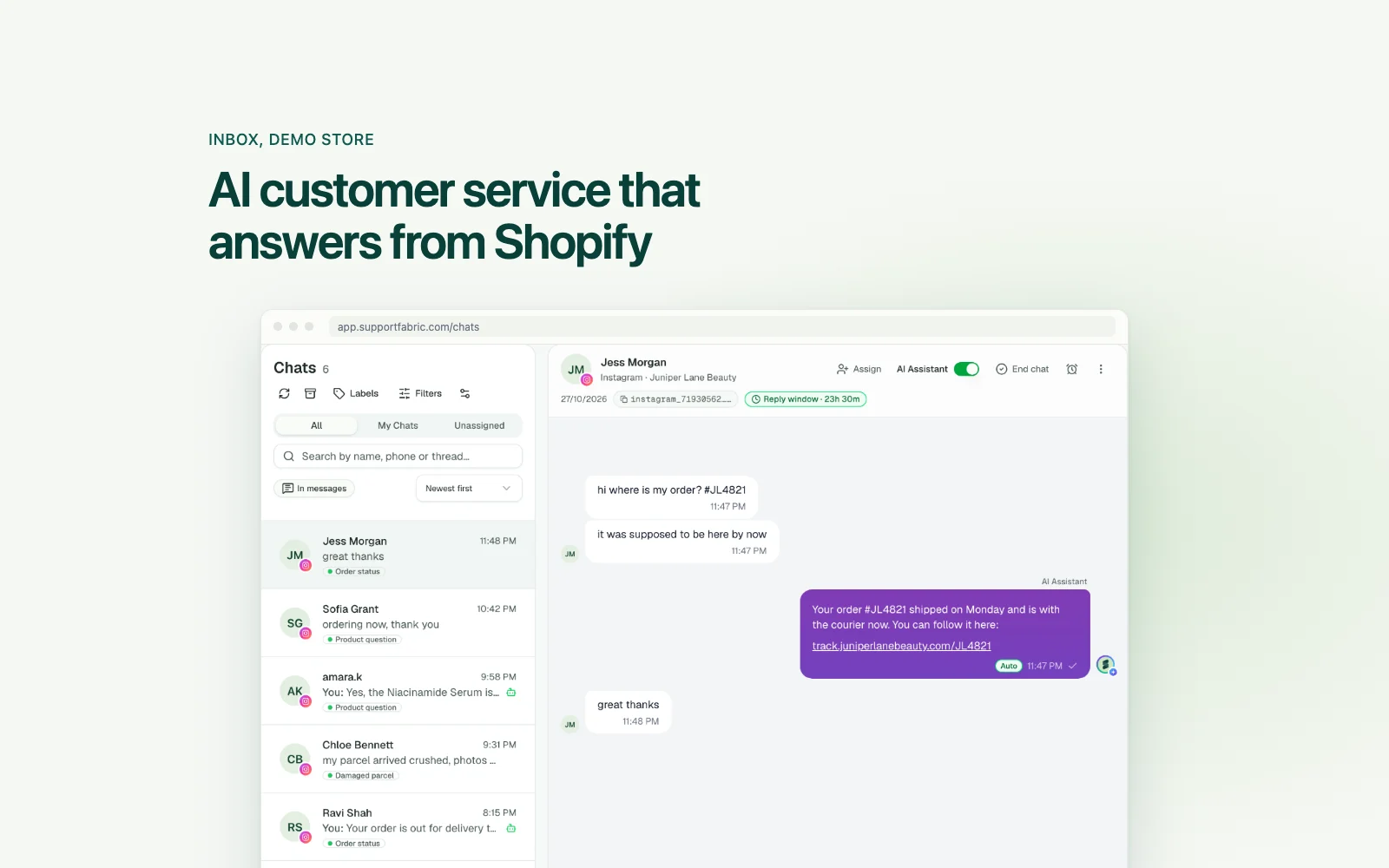
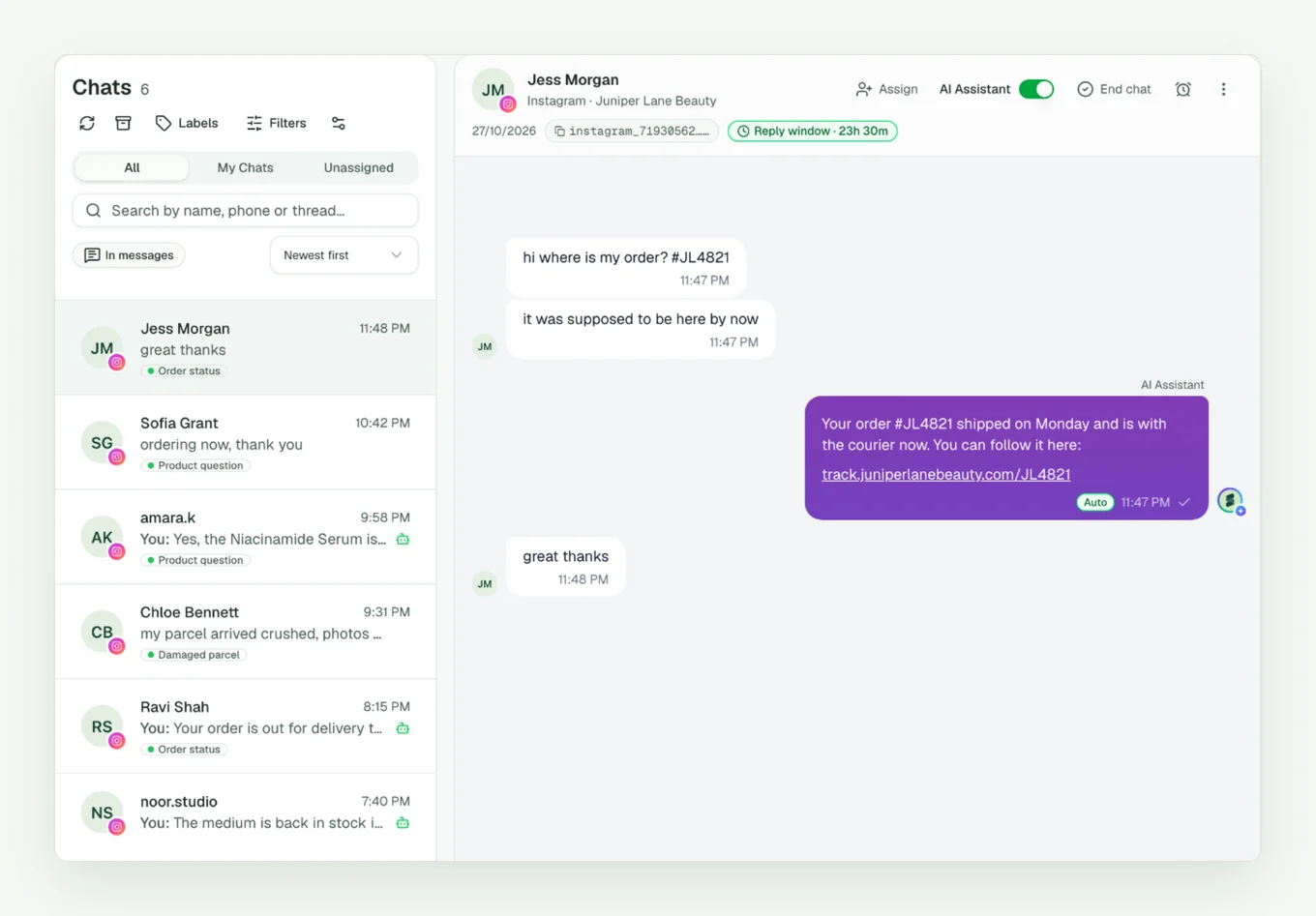
Start with where is my order, the biggest single question. The agent looks up the order and answers in the thread the customer used, with the courier, the tracking details and the status your store has on record. Cutting those questions before they are asked has its own playbook.
The other half is where the money is. Fit, sizes, ingredients, availability and recommendations get answered in under 30 seconds, 24/7. "Is the niacinamide serum fragrance free" is a buying question, and a customer asking at 1 AM is often ready to buy at 1 AM.
The agent understands voice notes and finds the matching product from a photo. When the customer is ready, it drops a ready-to-pay checkout link in the conversation, and for stores that take cash on delivery it can place the order in chat.
Older chatbots fell over here, because flow builders run on answers somebody typed in advance. An AI agent composes its answer from your catalog, policies and live orders.
Send any tool you are testing one message: "is the medium back in stock and will it arrive by Friday". A flow builder tends to catch one word and send the restock FAQ or the shipping page. A good agent checks the variant, tells the customer what your shipping rules say, and offers the checkout link.
The channel decides how much of this you get to use. For beauty, skincare, grooming and fashion brands, a customer often sees a creator's video and writes in Instagram DMs, or saves your WhatsApp number from the packaging. An agent that only works in the website widget leaves those threads unread.
What happens when the agent does not know
The fear behind "not another chatbot" is a wrong answer sent to a real customer with your logo on it. No software can promise that never happens. What you can control is what the agent does at the edge of what it knows.
You set those rules during onboarding: which topics it never answers on its own (a damaged product, anything medical about an ingredient, an angry customer), and what it says when it hands off. At that line the agent stops and passes the chat to a person. The customer stays in the same thread, and your team sees the history, so nobody repeats themselves.
Your team works in the helpdesk built in, so you do not need a separate one. They assign chats and add labels and internal notes. A damaged-product claim becomes a ticket with a priority, a status and an owner, instead of a DM that scrolls out of view.
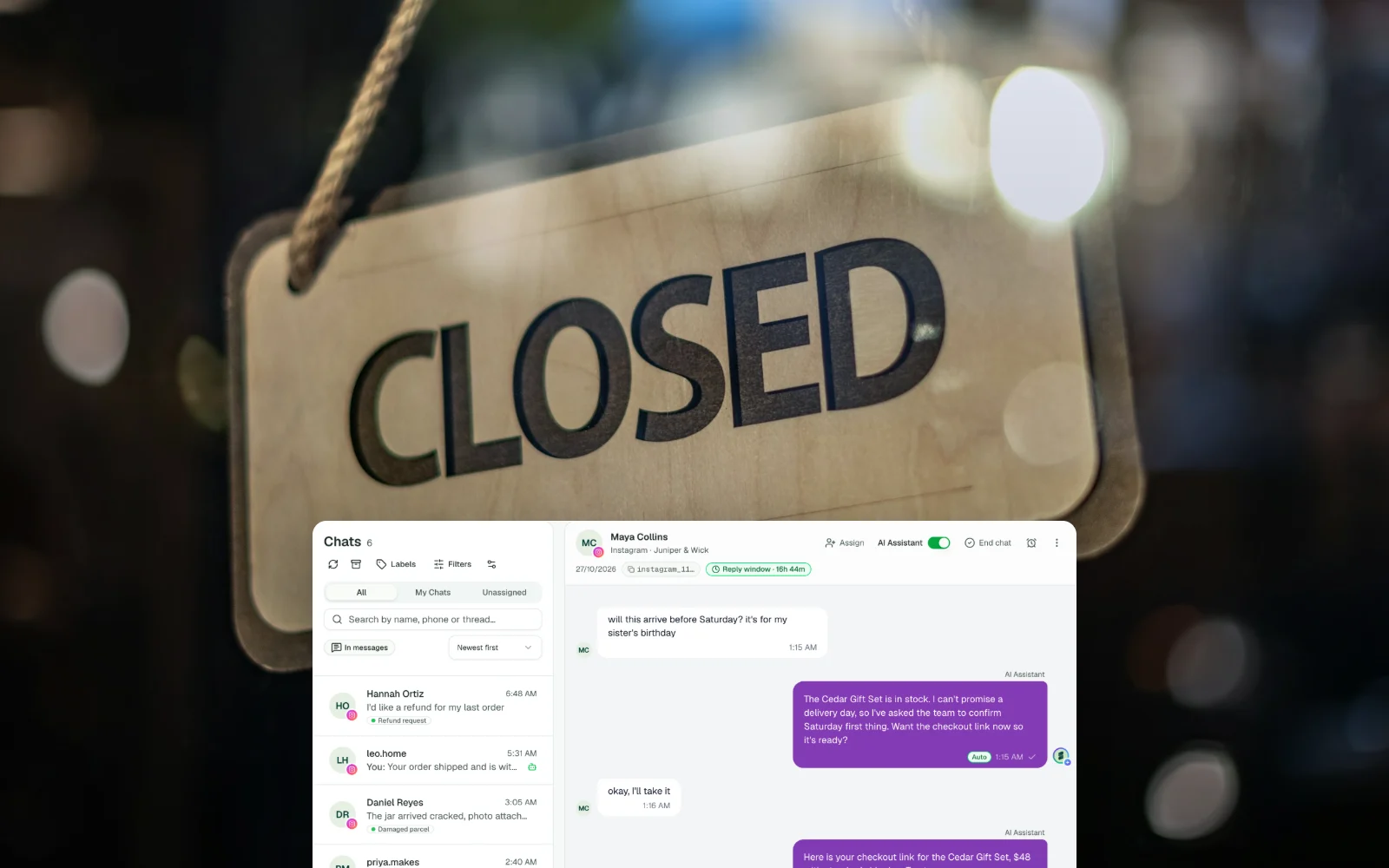
The order status at 11:47 PM never needed a person. The customer whose package arrived crushed does.
What setup involves
Whatever you buy, someone has to do this list:
- Train the agent on your products, sizing, shipping rules, returns and promotions.
- Decide how it talks.
- Decide what it never says.
- Decide when it hands off and what the customer is told.
- Connect each channel, with its own account setup.
- Read the first week of conversations and correct them.
With a software tool, that list is yours. With us, the list is ours. You book one 15-minute demo, then one 45-minute onboarding call. We build, train and launch the agent. You install an app, we do not need access to your store admin, and it is live in 48 hours.
Your cost is about an hour on calls, plus feedback on the first conversations. After launch, you ask for a change and we make it, included in the monthly fee, as long as the feature already exists. The Support Fabric overview has the rest.
What AI customer service for Shopify costs
Price three lines for any tool, including ours.
Software. The monthly fee, plus anything charged per seat, per answer or per ticket, at the volume you expect in six months.
AI usage. Ask what one conversation costs in AI and whether that number is marked up. Our Gorgias pricing breakdown shows how an AI answer can also count as a ticket.
People time. The hours for setup, the weekly hours to maintain it, and the staff who answer what the tool cannot. Nobody puts this line on the invoice.
Our three lines, as of November 2026. Software: one plan that covers the build, the training, the go-live and running the agent, on the pricing page. AI usage: at cost with no markup, 2 to 4 cents a conversation, so 50 conversations a day, about 1,500 a month, comes to $30 to $60. People time: about an hour of yours for setup, plus your team's time on the conversations the agent hands off. To compare vendors, run the same three lines on each. Our guarantee is written in orders: "50 orders closed inside your DMs in 50 days, or you don't pay."
Who should skip this
If you get fewer than 50 conversations a day, the math is thin. You can answer that yourself, and Shopify Inbox with its free agent may cover the website share. Come back when the inbox is eating your evenings.
If you sell only on Amazon, your conversations happen inside Amazon's messaging, so an agent built on your own store has nothing to work with.
If you handle 10,000 or more customer questions a month and need enterprise integrations, you want an enterprise platform, and we will lose that evaluation.
If you want to stay on your current helpdesk, or make every change in the tool yourself, we are a different shape: our helpdesk and agent come as one, and you ask us for the changes.
We fit a Shopify or WooCommerce brand with 50 or more conversations a day, most of them in Instagram DMs and WhatsApp, with or without a support team.
For AI customer service on Shopify, try Shopify's free Inbox agent if your conversations start on your site. If they start in Instagram DMs or WhatsApp, price software, AI usage and people time, then ask who trains the agent and connects the channels.
Common questions
Can AI customer service work in Instagram DMs and WhatsApp as well as web chat?
Yes. A Support Fabric AI agent answers on WhatsApp, Instagram DMs, Facebook Messenger, website chat and email, 24/7, with one helpdesk for your team. Shopify's own Inbox agent, by comparison, only operates in the online store chat widget, according to Shopify's Help Center as read on 2026-11-19.
Will an AI agent say the wrong thing to my customers?
It can, which is why you set its limits before it goes live. During the 45-minute onboarding call you decide how the Support Fabric agent talks, what it never says and which conversations go to a person. Past those lines, it hands the chat to your team with the history attached.
How long does setup take?
With Support Fabric, the AI agent is live 48 hours after onboarding. Your time is one 15-minute demo, one 45-minute onboarding call and installing an app, plus feedback on the first conversations.