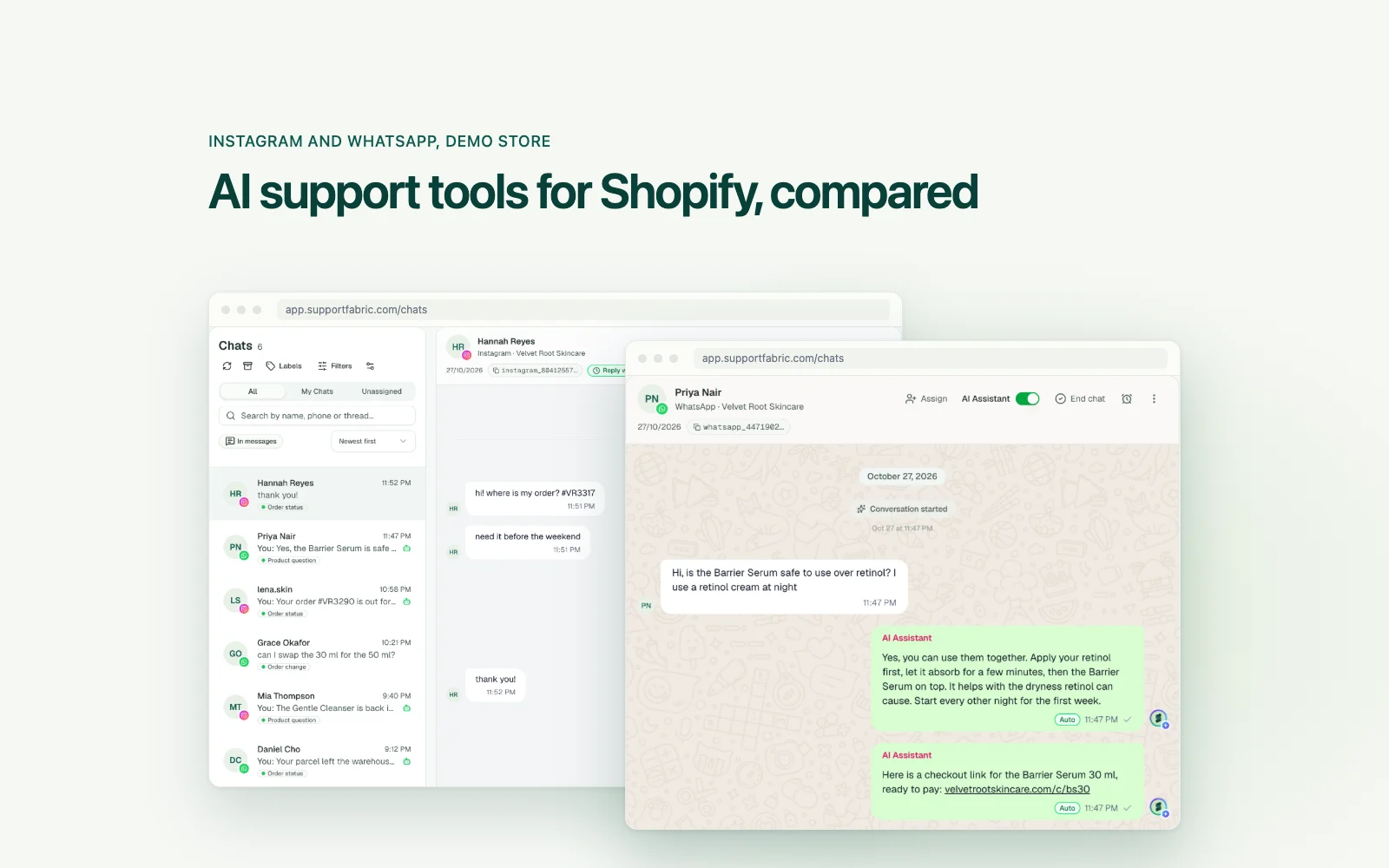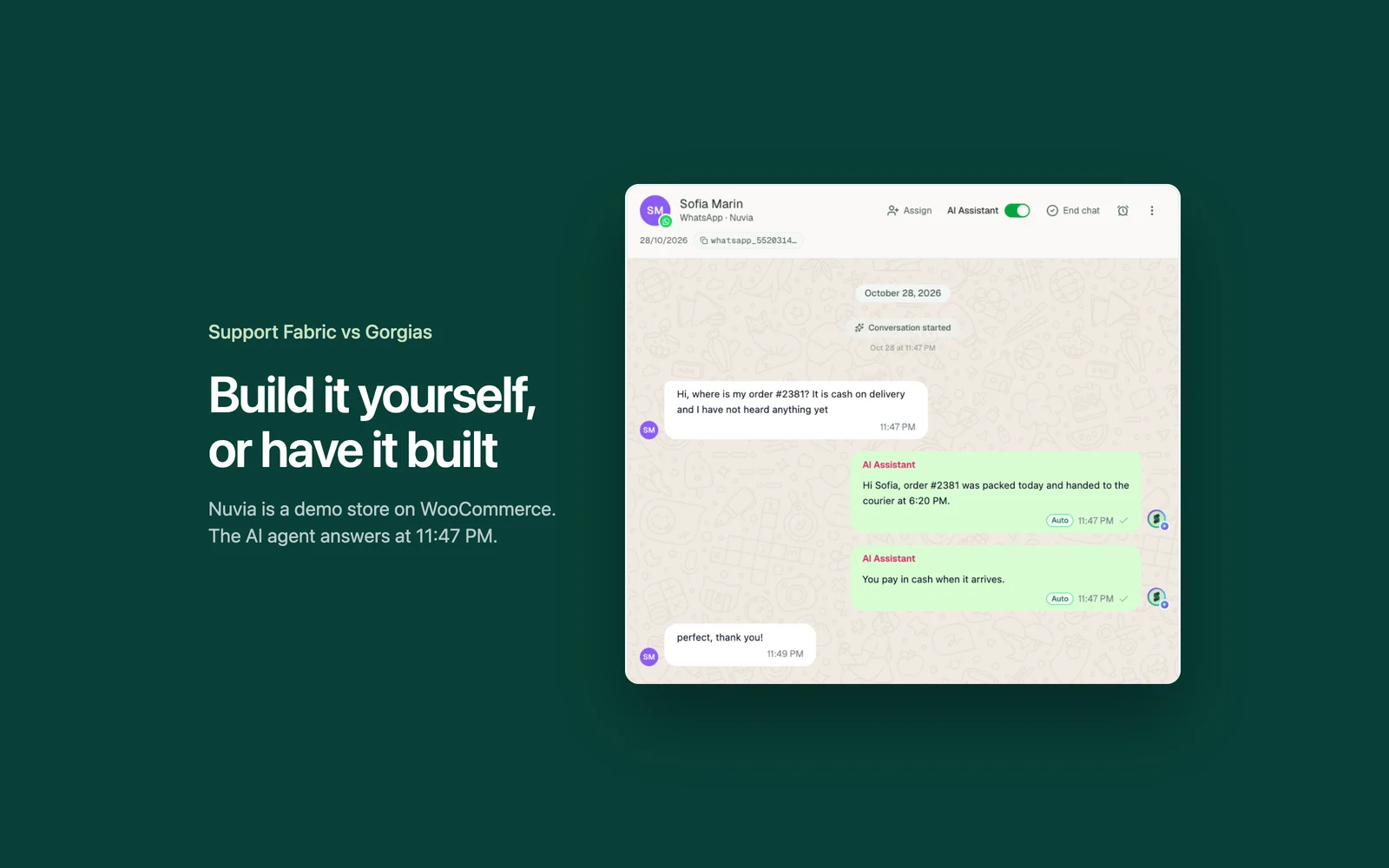
You reduce WISMO tickets in two moves: cut the questions that should never be asked, with dispatch windows and shipping notifications, then answer the rest automatically in the channel the customer used. Order tracking is roughly half of all customer queries across the stores we run (Support Fabric data, October 2026), so this is probably half of your support job, and it is the half that can run without you.
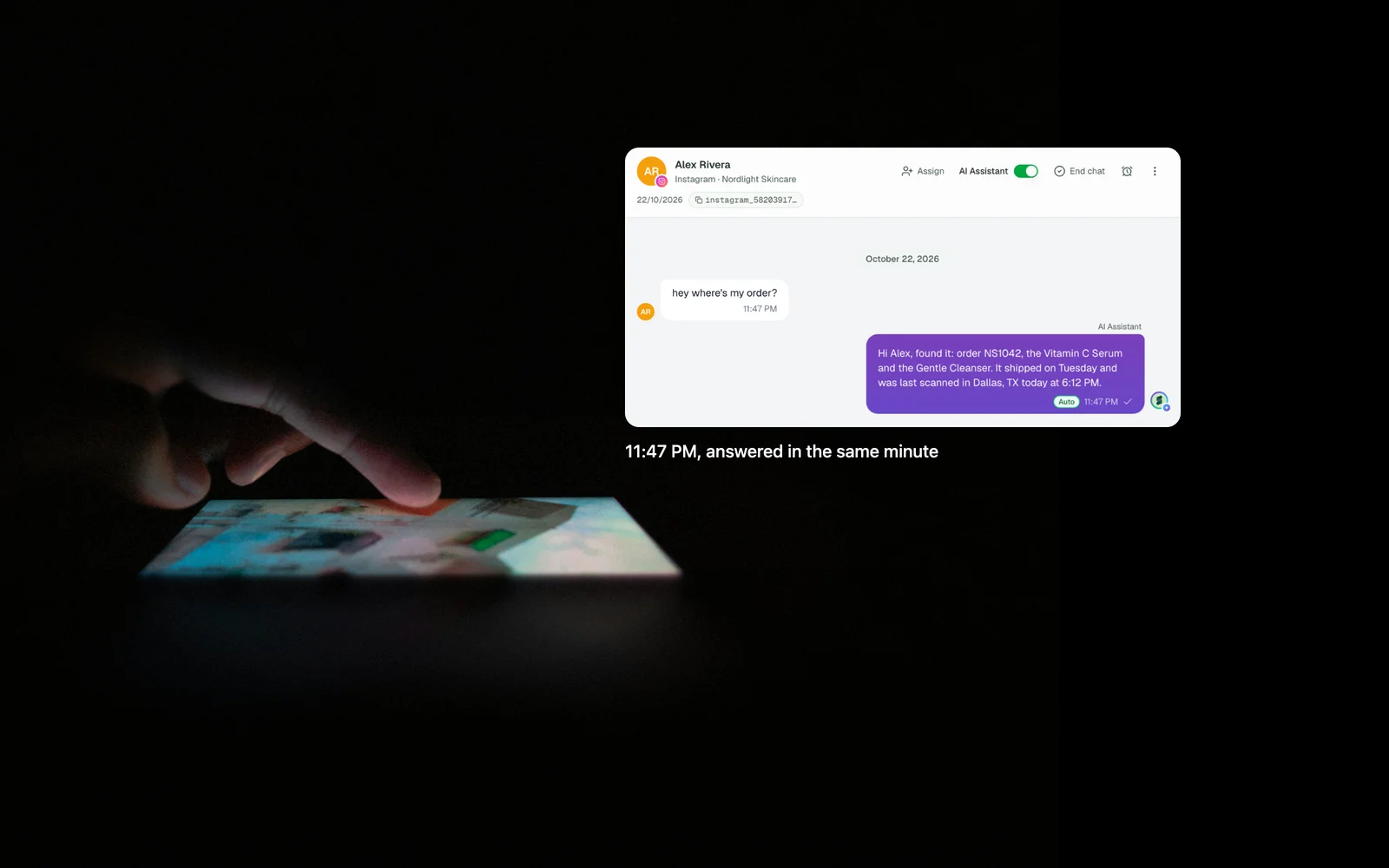
Here is what it looks like when it does not. Nordlight Skincare, a made-up store selling a vitamin C serum and a cleanser, gets an Instagram DM at 11:47 PM: "hey where's my order?" Nobody is awake. The customer sends "hello??" at 8:04 AM. The founder sees both messages at 9:30 AM, opens Shopify, finds the order and pastes the tracking number into the thread. Elapsed time: about ten hours. Content of the reply: one line that had been sitting in Shopify since Tuesday.
The standard advice, a tracking page and better notifications, does reduce the count. But those tactics live in email and on your website, and this customer is waiting in your Instagram thread.
Key facts
- Order tracking is roughly half of all customer queries across the stores Support Fabric runs (October 2026 data).
- A Support Fabric AI agent answers order status questions 24/7, usually within seconds. With the store's courier tracking connected, it gives the latest carrier status and the date of the last scan.
- Support Fabric puts five channels in one inbox: WhatsApp, Instagram DMs, Facebook Messenger, website chat and email.
- Support Fabric goes live in 48 hours. It builds and trains the agent and the store installs an app, so it never needs access to the store admin.
- Support Fabric is one plan covering build, training, go-live and running the agent, with AI usage billed at cost. The current figures are on our pricing page.
What is WISMO?
WISMO stands for "where is my order". It is the message a customer sends to ask about an order they have already paid for. A WISMO ticket is one of those messages logged in a helpdesk or shared inbox, whether it arrived as an email, an Instagram DM or a WhatsApp voice note.
"Has this shipped yet?" and "my tracking hasn't moved in four days" are WISMO too. The customer wants a date and a location, so "it's on its way" fails the question even when it is sent quickly.
How to reduce WISMO
The standard playbook has five parts, and all five work. Do them first.
- Put a real dispatch window where the customer decides to buy. "Ships in 1 to 2 business days" on the product page and order confirmation removes a common WISMO: checking whether you shipped at all.
- Send a notification at every milestone. Confirmed, shipped, out for delivery, delivered. Shopify offers the shipping email only when you have the customer's email address (Shopify Help Center), so check how many orders arrive without one.
- Give customers a place to look up their order. Shopify documents three routes: a customer account, the shipping confirmation link, or the order number plus email or phone (Shopify Help Center). Pin the link in your Instagram bio.
- Quote honest delivery dates. "5 to 8 business days after dispatch" lets a customer work out whether it is time to worry yet.
- Check addresses at checkout. A missing apartment number becomes a week of WISMO messages.
Several pages ranking for this keyword attach a percentage to each tactic. Those numbers belong to the vendors who measured them, so measure your own.
Track four numbers once a week: the share of conversations that are order status, the share of those answered without a human, first reply time from the customer's message, and reply time after 10 PM on its own, because overnight gaps of ten hours hide inside a daytime average.
Why the playbook stalls in DMs
Everything above assumes the customer will go somewhere to find the answer. For a brand selling through Instagram and WhatsApp, that fails three ways.
The customer is already in a thread with you. When they want to know where the parcel is, they type four words into the thread that is already open. The tracking page is a second place to go, and nobody goes to a second place at 11:47 PM.
Voice notes cannot click anything. At the beauty and fashion brands we run, some WhatsApp questions arrive as voice notes, and the customer who sent one expects a reply in the same thread.
The shipping email went to an address the customer does not check. Guest checkout with a throwaway email, or a gift. The notification fired, and from the customer's side you never said anything.
So the playbook cuts the count and then plateaus. Order status is the biggest slice of what is left, and the first job to hand to AI customer service.
What an automatic answer does
Four steps happen inside one reply, at any hour.
- Match the customer to the order. If the phone number on the order does not match, the answer needs a fallback: the order number, or a full name and postal code.
- Read the current carrier status. The last scan, its date and its location.
- Say what it means, with a date. "Shipped Tuesday, last scanned in Dallas on Thursday" answers the question. "Your order is on its way" gets you the same question tomorrow.
- Reply in the same channel. An Instagram DM gets an Instagram DM. A WhatsApp voice note gets a message in the same thread.
Automate this first because of the roughly-half figure: one question, with a known answer in your order data, arriving at all hours. If you want the hours first, what answering "where's my order" by hand costs is worked through on its own page.
Five edge cases to decide first
Decide each of these in writing before you switch anything on.
No order found. The reply asks for one alternative identifier and stops after two attempts. Then a person takes it.
Different email or phone number. Ask for the order number first, then full name and postal code. A person handles any mismatch before an address is read out.
Stuck shipment. Define stuck as a number, for example no new carrier scan in 3 days domestically, and hand off at that point. USPS accepts a Missing Mail search request starting 7 days from mailing (USPS), so a carrier case can follow at 7.
Delivered but not received. Automate the intake and leave the decision to a person. Confirm the delivery scan, collect what a carrier case needs and pass the thread over.
When a human takes over. The hand-off happens in the same inbox and the same thread, so the customer never repeats themselves.
The sale after the status
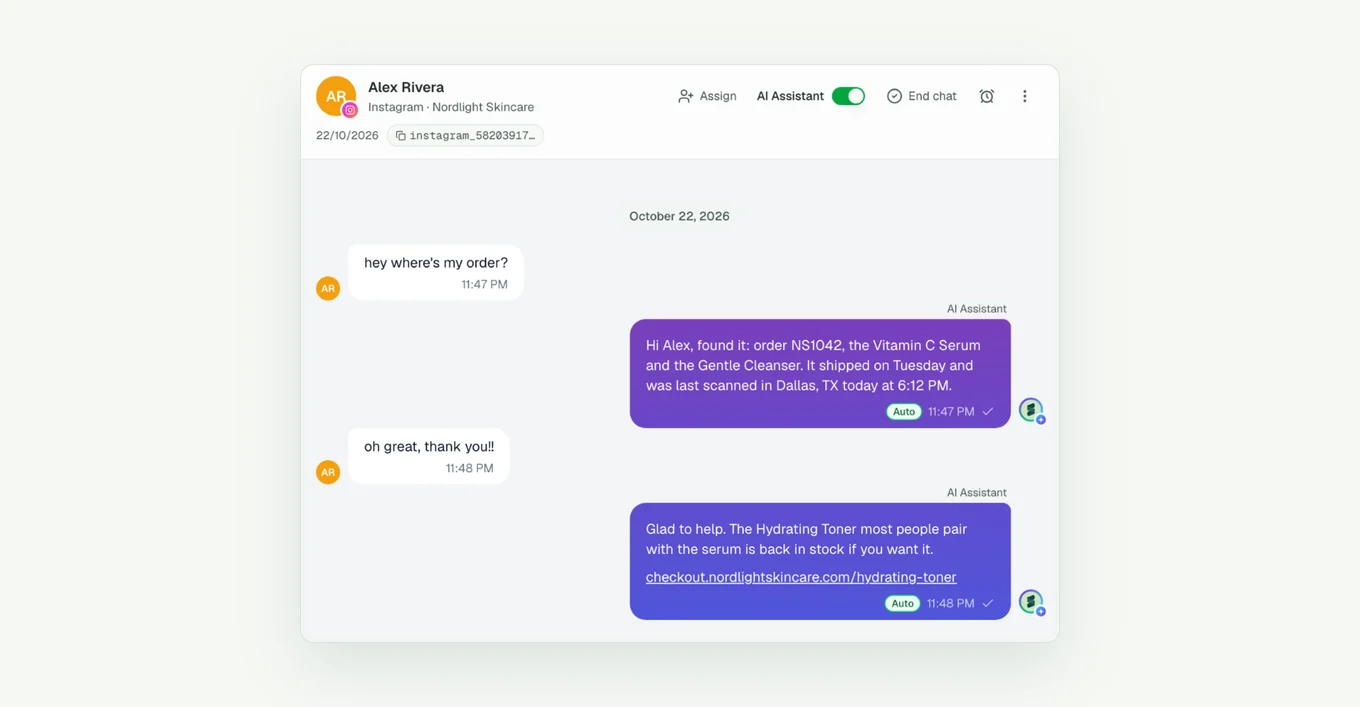
Once the status is answered, the customer is still in the thread. On a tracking page, that moment ends with a tab closing. In a DM, you can say "the toner most people pair with the serum is back in stock".
Support Fabric is a done-for-you AI customer support service for Shopify and WooCommerce brands. It deploys a custom AI agent across WhatsApp, Instagram DMs, Messenger, website chat and email that answers customers in seconds, tracks orders, recommends products and closes sales in chat, with a 48-hour go-live. On a Shopify store, the agent can drop a ready-to-pay checkout link into the conversation and, for brands that offer it, place a cash-on-delivery order in chat. Your team works beside it in the same inbox for the hand-offs above.
A men's grooming brand running this converts 1 in 13 chats into an order and cut its support team from 10 people to 2 (Support Fabric client data). The data post on AI chat conversion rate shows how to work that out for your store, and What is Support Fabric? has the full facts.
To reduce WISMO tickets, cut avoidable questions with dispatch windows, notifications, honest dates and address checks. Then answer the rest automatically in the channel the customer used, with the carrier status and a date, and hand the edge cases to a person by a written rule.
Common questions
What percentage of support tickets are order status questions?
Across the stores Support Fabric runs, order tracking is roughly half of all customer queries (October 2026 data). Your share depends on dispatch speed and how clearly you set delivery expectations. Treat any industry percentage without a linked source as marketing, and count your own from a week of conversations.
Does a branded tracking page reduce WISMO?
A branded tracking page reduces the share that arrives from customers who are willing to go and look. It does little for a customer who asks in an Instagram DM at 11:47 PM, because the page is a second place to go and they are already in a thread with you. A WhatsApp voice note cannot open it at all. Build the page, then answer the DMs in the DMs.
Can WISMO be answered automatically on WhatsApp and Instagram?
Yes. An AI agent connected to your store's orders and courier tracking can match the customer to the order, read the carrier status and reply in the same WhatsApp or Instagram thread, usually within seconds, 24/7. Support Fabric does this from one inbox, with a person taking over in the same thread for the edge cases.