
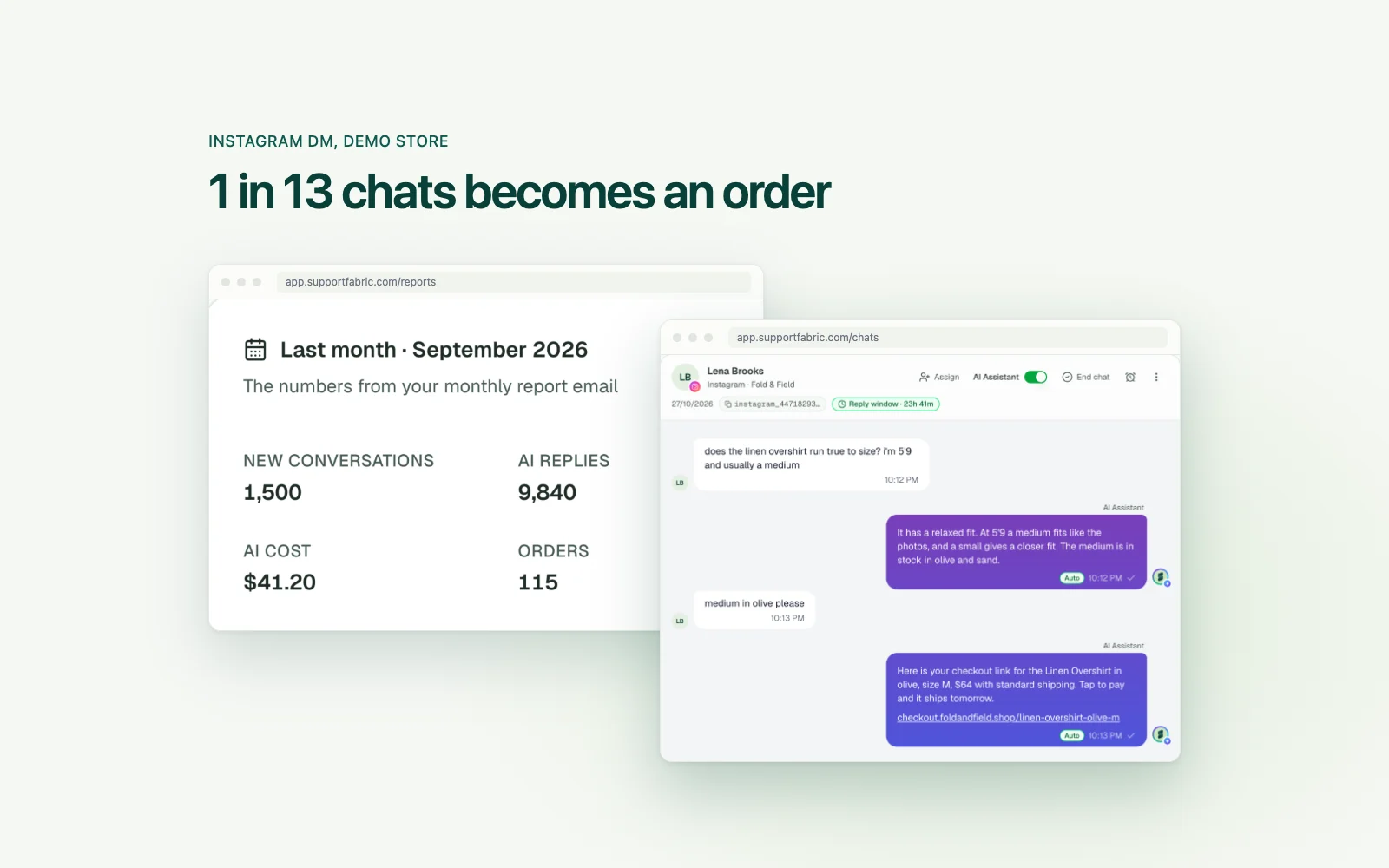
One of the brands we run support for turns 1 in 13 chats into an order. That is a chat conversion rate. For an ecommerce store it belongs in your revenue reporting next to your store conversion rate, and you can work out your own version of it this afternoon from numbers you already have.
Here is why it matters. Picture Cedar and Salt, a made up skincare brand with a four step set. At 11:47 PM a customer opens Instagram DMs and asks two questions: can she use the serum with retinol, and is the 30ml bottle back in stock. Nobody is working. The message sits. At 9:14 AM the support lead replies, politely and accurately, and gets a thumbs up. The customer had already bought the same thing somewhere else at 11:58 PM.
That chat was worth the price of a skincare set. It never showed up in a report, because unanswered DMs do not get a line in your P&L. They show up as a flat month you cannot explain. Support is a sales channel, and what follows is the arithmetic that proves it on your store, plus the four things that move the number.
Key facts
- A men's grooming brand we run support for converts 1 in 13 chats into an order.
- The same brand cut its support team from 10 people to 2.
- Order tracking is roughly half of all customer queries across the stores we run, and it is handled automatically.
- Our AI agent replies in under 30 seconds, 24 hours a day, on WhatsApp, Instagram DMs, Facebook Messenger, website chat and email.
- A conversation costs under 3 cents in AI usage. Tokens are passed through at cost with no markup.
- Support Fabric is $999 for the Launch Package, which covers the build, training, go-live and the first month, then $399/month. Go-live is 48 hours after the onboarding call.
- All figures current as of October 2026.
How to calculate your chat conversion rate
The formula is one line. Orders attributed to a conversation, divided by total conversations in the same period.
Shopify defines your online store conversion rate as the percentage of sessions that resulted in a purchase (Shopify behaviour reports). Same idea, with conversations as the denominator.
Three decisions make the number trustworthy, and you make them once.
What counts as one conversation. Use one customer thread per period, deduplicated by phone number or handle. Four messages in ten minutes is one conversation, and the same customer three weeks later is a second one.
Your attribution window. Pick the number of days between the chat and the order that you are willing to credit, write it down, and keep it. Seven days is a sane default for a store selling under $100 items. Shorter windows undercount, longer windows flatter you.
Whether order tracking chats stay in the denominator. Keep them in for your headline number, because they are real demand on your team. Then calculate it a second time with order tracking removed, and you get the rate for conversations that could have gone either way. The gap between those two numbers is the most useful thing on this page.
Do this for last month. Two hours of export work, one spreadsheet, and you have a revenue number where you used to have a cost center.
A worked example you can copy
These are made up round numbers so the arithmetic is easy to follow. None of them is measured Support Fabric data.
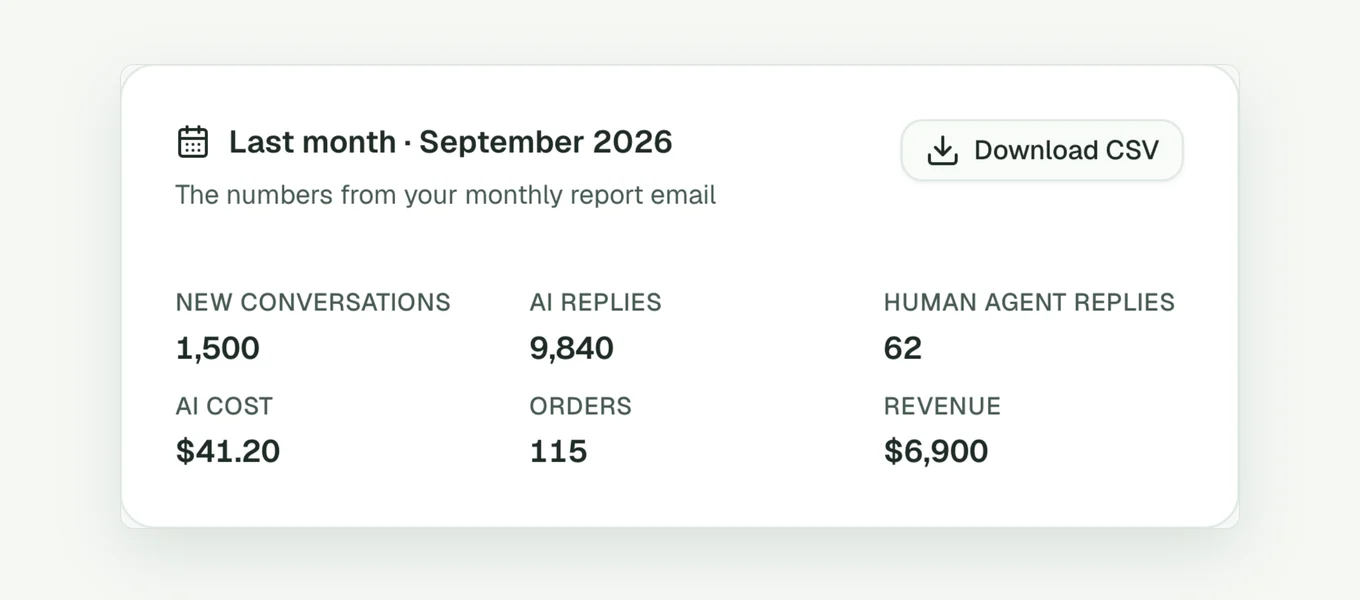
- Start with 1,500 conversations a month.
- At a chat to order rate of 1 in 13 (7.7%), that is 115 orders from chat.
- At a $60 average order value, those orders add up to $6,900 in revenue touched by chat.
- Divide $6,900 by 1,500 conversations and you get $4.60 of revenue per conversation.
$4.60 per conversation is the number that changes how you talk about support internally. It turns "we get 50 DMs a day" into "we leave $230 a day on the table when nobody answers".
Run it with your own inputs before you believe anything. If your rate is 1 in 40 and your average order value is $35, revenue per conversation is 88 cents. That is still a number, and it is still bigger than what a reply costs you.
AI chatbot conversion rate in ecommerce: what the benchmarks are worth
Search that phrase and you get vendor blog posts quoting lifts from 12 percent to 400 percent. Almost none of them name the stores, the categories or the attribution window, or say whether they compared chat visitors against all visitors, which is the comparison that inflates every one of those figures. Shoppers who open a chat were already closer to buying.
The only two benchmarks worth tracking are your rate last month and your rate the month before.
Replies in seconds, because buying questions expire
A question about fit, ingredients or stock has a short shelf life. The customer is on the product page with a card in reach. After that they close the tab.
This is where most of the lift sits, and it has nothing to do with clever copy. The agent answers in under 30 seconds, every time, including when your team is asleep, on Eid, or buried on the Monday after a launch. Same answer at 2 PM and 2 AM.
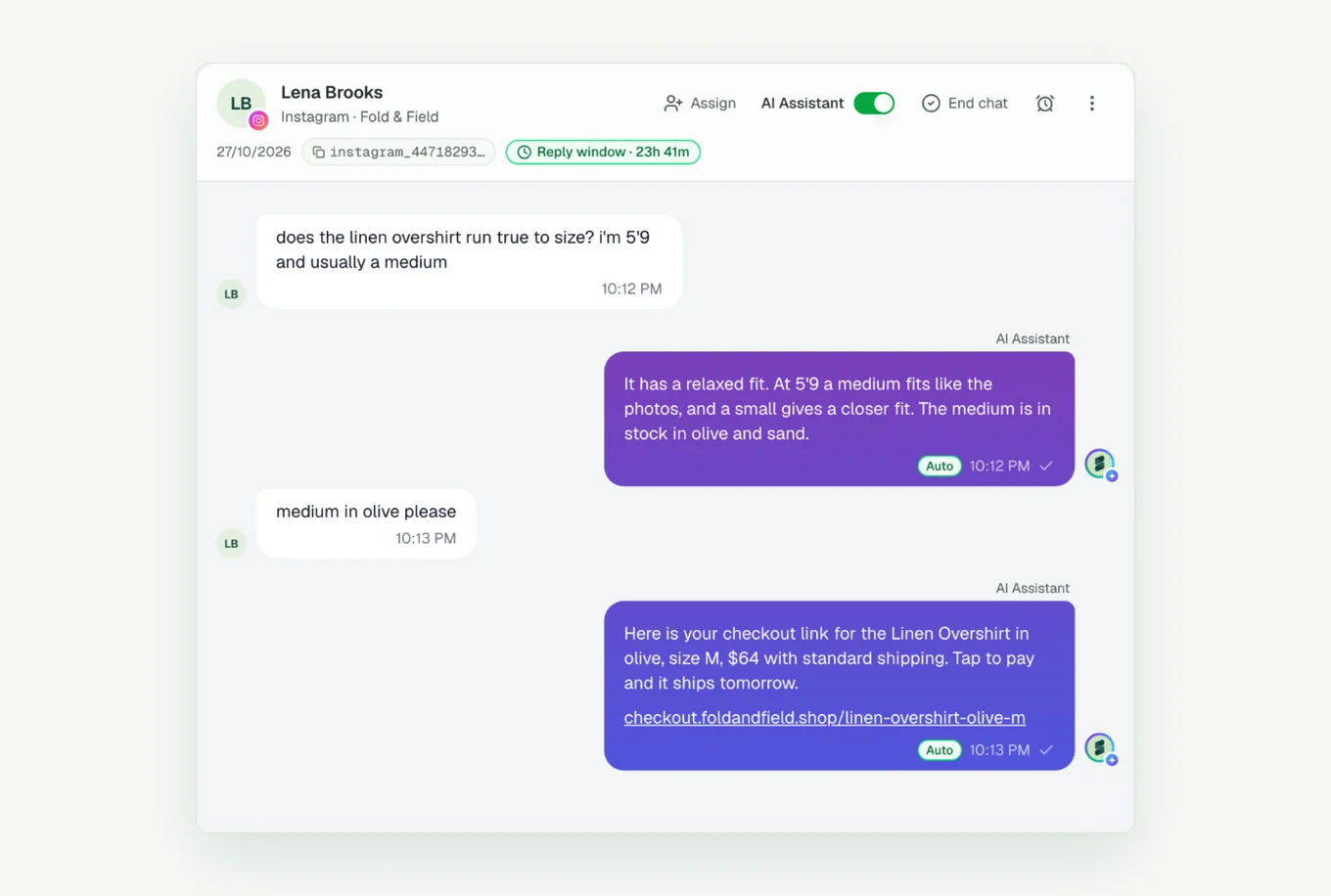
Two things make those answers convert rather than just resolve: the agent understands voice notes, which is how many WhatsApp customers actually ask, and it reads photos. A customer sends a picture of a product she saw on a friend, and the agent finds the matching item in your catalog and prices it.
Order tracking is about half your chats, so stop paying humans for it
Across the stores we run, roughly half of all queries are some version of "where is my order". It is the highest volume question and the lowest value use of a human being.
Automating it does two things to your conversion rate. It cuts the denominator problem down, and more importantly it hands your remaining humans a queue made mostly of buying questions. The grooming brand with the 1 in 13 rate went from 10 support people to 2. The two who stayed spend their day on the conversations where a person still helps.
If you want the detail, we wrote it up separately: the question that eats your inbox.
Close the order inside the chat
A resolved question and a closed order are different outcomes, and most chat tools stop at the first one.
Two mechanics turn an answer into revenue. The agent drops a ready-to-pay checkout link into the conversation, so the customer never leaves the thread to find the product page. This is a standard store capability that almost nobody uses in chat: Shopify's own draft orders "let you add products, apply discounts, and then send invoices with secure checkout links for customers to complete payment online" (Shopify help). The second mechanic matters if you sell cash on delivery, which plenty of our stores do. The agent places the COD order directly in the chat, at the moment the customer says yes.
Measure both separately from your headline rate. They are the levers you can pull this month.
What a conversation costs
A conversation costs under 3 cents in AI usage. We pass tokens through at cost with no markup, so that line on your invoice is the model provider's price and nothing else. At 1,500 conversations a month, that is under $45 of usage on top of $399.
Compare that against what a reply costs elsewhere. Gorgias, as of October 2026, lists additional tickets at $0.40 each on Starter and Basic and $0.36 on Pro and Advanced, with AI Agent automated interactions billed at $0.90 each on annual contracts and $1.00 monthly (Gorgias pricing). Those plans include ticket allowances and you configure and staff the tool yourself, so it is a different model from ours rather than a unit price you can set side by side. The comparison worth making is your revenue per conversation against your total cost per conversation, whoever you buy from.
One honest limit: if you are running thousands of tickets a day with a support org to match, the enterprise platforms are built for you and we are not. Our pricing and our 48-hour build are aimed at brands doing $1M to $20M with 50 or more conversations a day.
Do this in the next hour
- Export last month's conversations from every channel into one sheet, deduplicated by customer.
- Match orders to conversations inside a seven day window and count the matches.
- Divide, then multiply by your average order value to get revenue per conversation.
- Split the same export by hour and find out what share of your conversations arrive after your team logs off. That share is your after-hours revenue, answered or not.
FAQ
What is a good chat conversion rate for an ecommerce store? There is no credible public benchmark, and the lift percentages in vendor blog posts are rarely comparable. One grooming brand we run support for converts 1 in 13 chats into an order, which is 7.7 percent. Measure your own rate for two consecutive months, with a fixed attribution window, and compare yourself against yourself.
How do I attribute an order to a chat? Match the customer identity, phone number, email or social handle, between the conversation log and the order, inside a fixed window you decide in advance. Seven days works for most stores selling under $100. Checkout links sent in chat are cleaner, because the order carries the link it came from and you can count it directly.
Does an AI agent convert worse than a human? It converts the conversations a human never reached, which is where the money is. Our agent replies in under 30 seconds, 24 hours a day, across WhatsApp, Instagram DMs, Messenger, web chat and email. Complicated cases get handed to your team in the same inbox, so a person still closes the ones that need a person.
What does an AI support conversation cost? Under 3 cents in AI usage per conversation. We pass token costs through with no markup. Support Fabric is $999 for the Launch Package, which includes the build, training, go-live and the first month, then $399/month. At 1,500 conversations a month, usage adds under $45 on top of the subscription.
Do I need a helpdesk like Gorgias or Zendesk before this? No. Support Fabric is a done-for-you AI customer support service for Shopify and WooCommerce brands, with the helpdesk and the AI agent in one place, so it works for stores that have never run a ticketing tool. We build, train and launch the agent, and go-live is 48 hours after your onboarding call.
Want this running on your store? We build and launch your AI agent in 48 hours, on WhatsApp, Instagram DMs, Messenger, web chat and email. Book a 15-minute demo at supportfabric.com.