A WhatsApp chatbot for Shopify built as an AI agent reads what the customer typed or said, answers from your catalog and your order data, and sends a checkout link so the sale closes from the thread. Running it costs three things: Meta's per-message fees, a provider or app, and the AI usage.
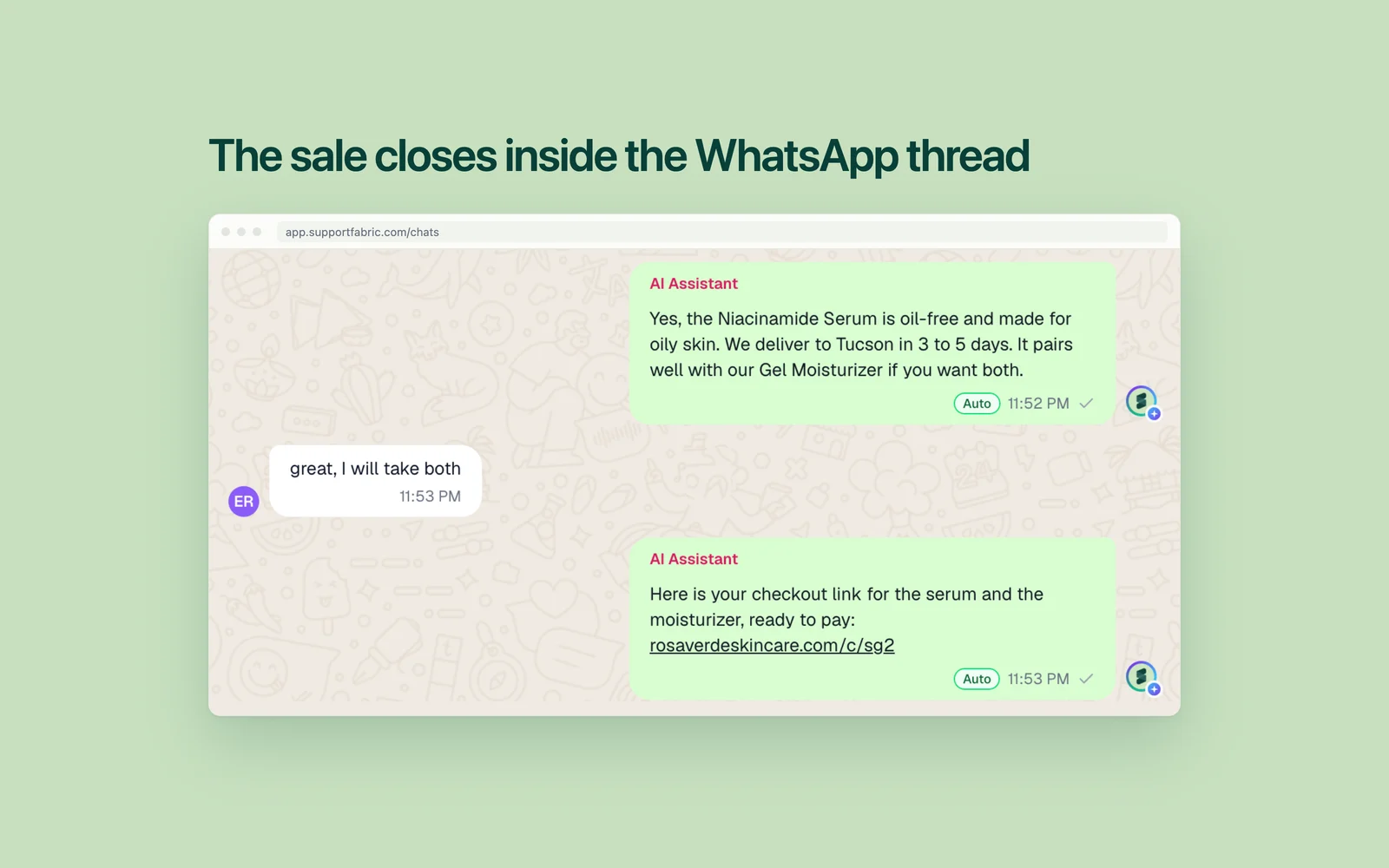
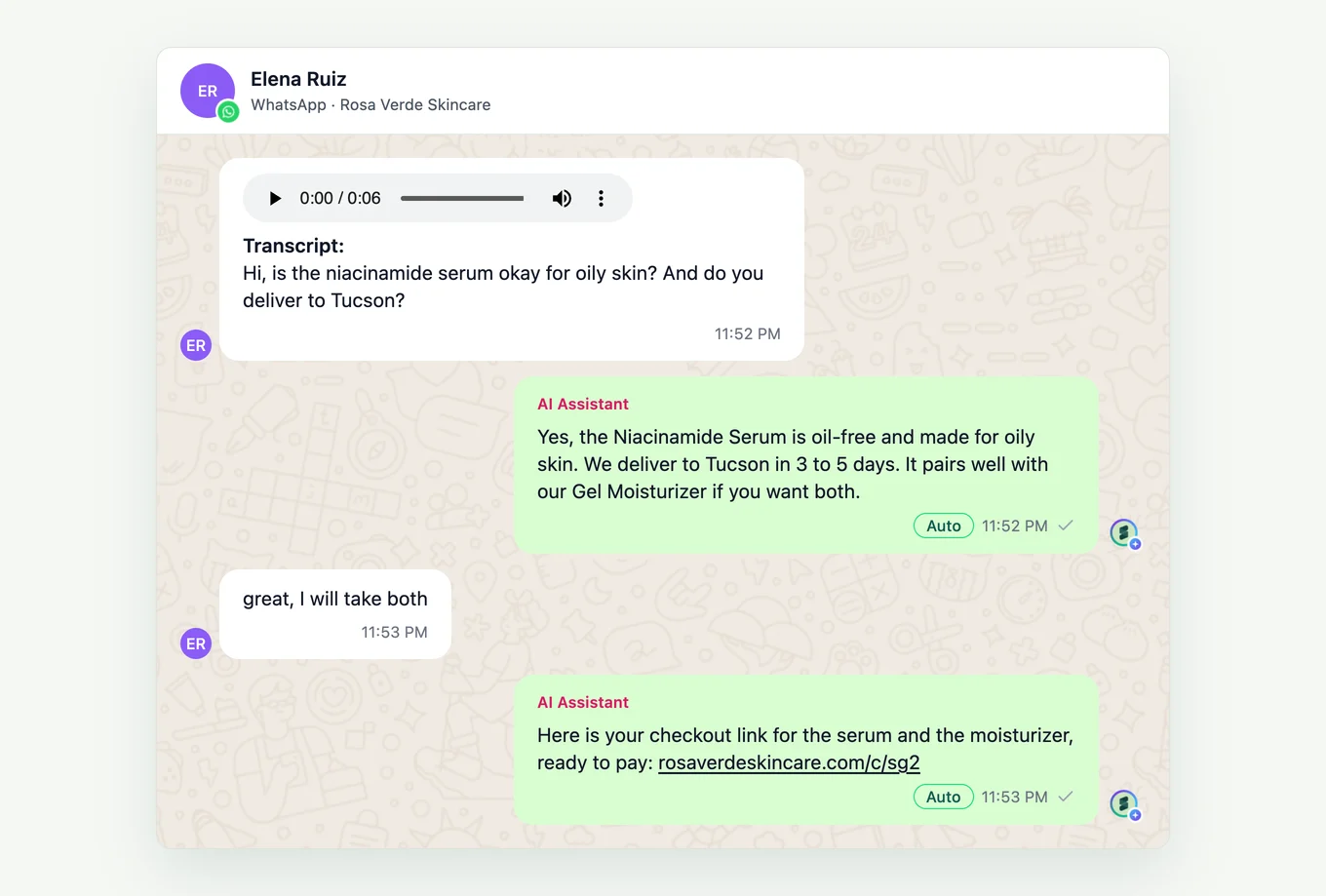
Here is what that looks like at 11:52 PM, with a made-up store standing in for the real ones. Rosa Verde Skincare, a small Shopify brand, gets a WhatsApp voice note. The customer asks whether the niacinamide serum is fine for oily skin and whether the store delivers to Tucson. Nobody at the brand is awake. The agent transcribes the voice note, answers both questions from the product page and the shipping rules, suggests the serum with the matching gel moisturizer, and drops a ready-to-pay checkout link. The order is paid and in Shopify at 11:58 PM. The founder sees it at breakfast.
Key facts
- Meta charges per delivered message on the WhatsApp Business Platform, at a rate set by message category and the customer's country code (Meta pricing page, read 2026-11-17).
- Each business phone number gets 1,000 free delivered service messages a month. Since October 1, 2026 Meta charges from the 1,001st (Meta pricing page, read 2026-11-17).
- Automated replies are allowed inside the 24-hour customer service window, as long as the customer has a prompt, clear, direct route to a person (WhatsApp Business Messaging Policy, read 2026-11-17).
- Meta's messaging limits count messages sent outside that window, starting at 250 customers in a moving 24 hours (Meta messaging limits page, read 2026-11-17).
- As of November 2026, Support Fabric answers WhatsApp, Instagram DMs, Messenger, website chat and email, live 48 hours after the onboarding call, with AI usage passed through at cost. Details are on the pricing page.
What the agent does
Support Fabric is a done-for-you AI customer support service for Shopify and WooCommerce brands. It deploys a custom AI agent across WhatsApp, Instagram DMs, Messenger, website chat and email that answers customers in seconds, tracks orders, recommends products and closes sales in chat, with a 48-hour go-live.
On WhatsApp, the agent does six things across the stores we run:
- Answers questions about fit, sizes, ingredients and availability in under 30 seconds, at any hour.
- Tracks orders, roughly half of all customer queries across our stores.
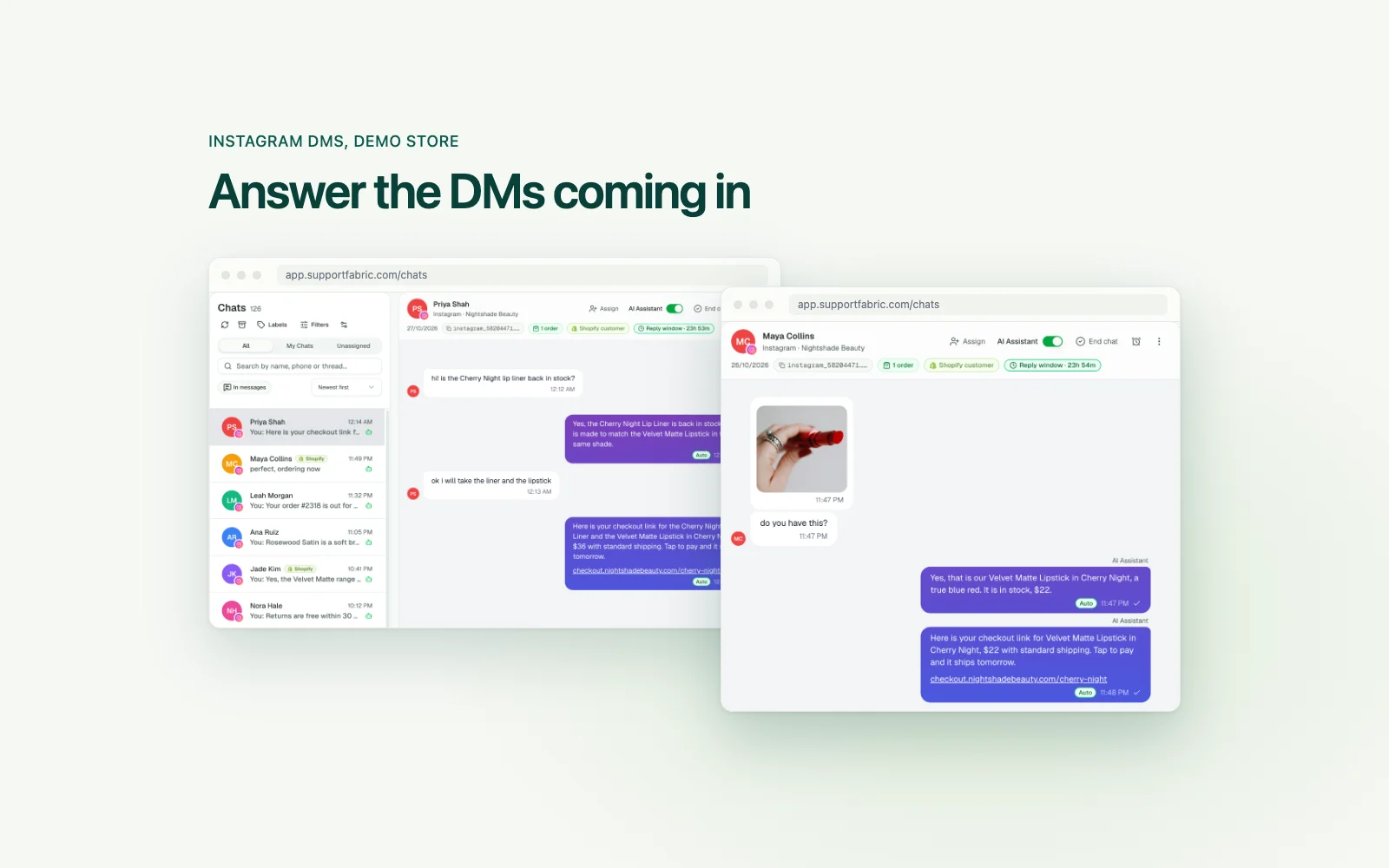
- Understands voice notes, and reads a photo to find the matching product.
- Drops a ready-to-pay checkout link into the conversation.
- Places cash-on-delivery orders in chat for stores that offer it.
- Hands off to your team in the helpdesk built in, with labels, notes and assignment.
If your WhatsApp is mostly order-status questions today, start there: what that question costs by hand has its own page. The same agent answers on every other channel.
How does a WhatsApp chatbot work?
A WhatsApp AI agent has four parts. First, the WhatsApp Business Platform, Meta's API for businesses. Meta's documentation says it lets a business "programmatically message and call on WhatsApp", and that each message a customer sends to your number reaches your software "via webhook".
Second, a provider or app in the middle, which receives that message and sends the reply back through the API. In our case that is the service we run for you.
Third, the agent. It reads the message, including a voice note or a photo, calls your store for what it needs, and replies in the voice you set during onboarding.
Fourth, the store connection. With Support Fabric you install an app on your Shopify or WooCommerce store, and we never need your admin login. That app is how the agent quotes stock, pulls tracking and builds a checkout link for the exact variant the customer asked about.
A personal WhatsApp number cannot run any of this. The WhatsApp Business app gives you greetings, away replies and, on Meta's own page, Meta's AI agent. An agent connected to your store needs the Business Platform, and Meta lets a Business app number connect to the API and stay on the app, with limits.
Is a WhatsApp chatbot free?
No, once you have real volume. There are three cost lines, and the first is Meta's whichever app or service you pick.
Meta's per-message fees. Meta's pricing page says that since July 1, 2025 it charges per message, and only when the message is delivered. The rate depends on the message category and the customer's country code, across 47 markets as of October 1, 2026.
Each business phone number gets 1,000 free delivered service messages a month, which do not roll over. On October 1, 2026 Meta resumed charging for service messages past that tier and for utility messages sent inside an open customer service window. Rates move, on the first day of a quarter at most, so we quote none here.
A provider or app. The monthly fee for whatever runs the agent, plus your time or a build fee for setup. Every vendor prices this differently, so it is the line to compare, and our comparison of six tools is a start.
AI usage. We pass it through at cost, and across our stores a conversation costs 2 to 4 cents.
With Support Fabric, one plan covers the build, the training, the go-live and running the agent, listed on our pricing page. Add AI usage at cost and whatever Meta bills you.
Count the WhatsApp replies your store sent last month. If an agent would send more than 1,000 on one number, Meta's fee applies from the 1,001st. Put a payment method on file: past the free tier, Meta says it stops delivering service messages to businesses without one.
Closing the sale inside WhatsApp
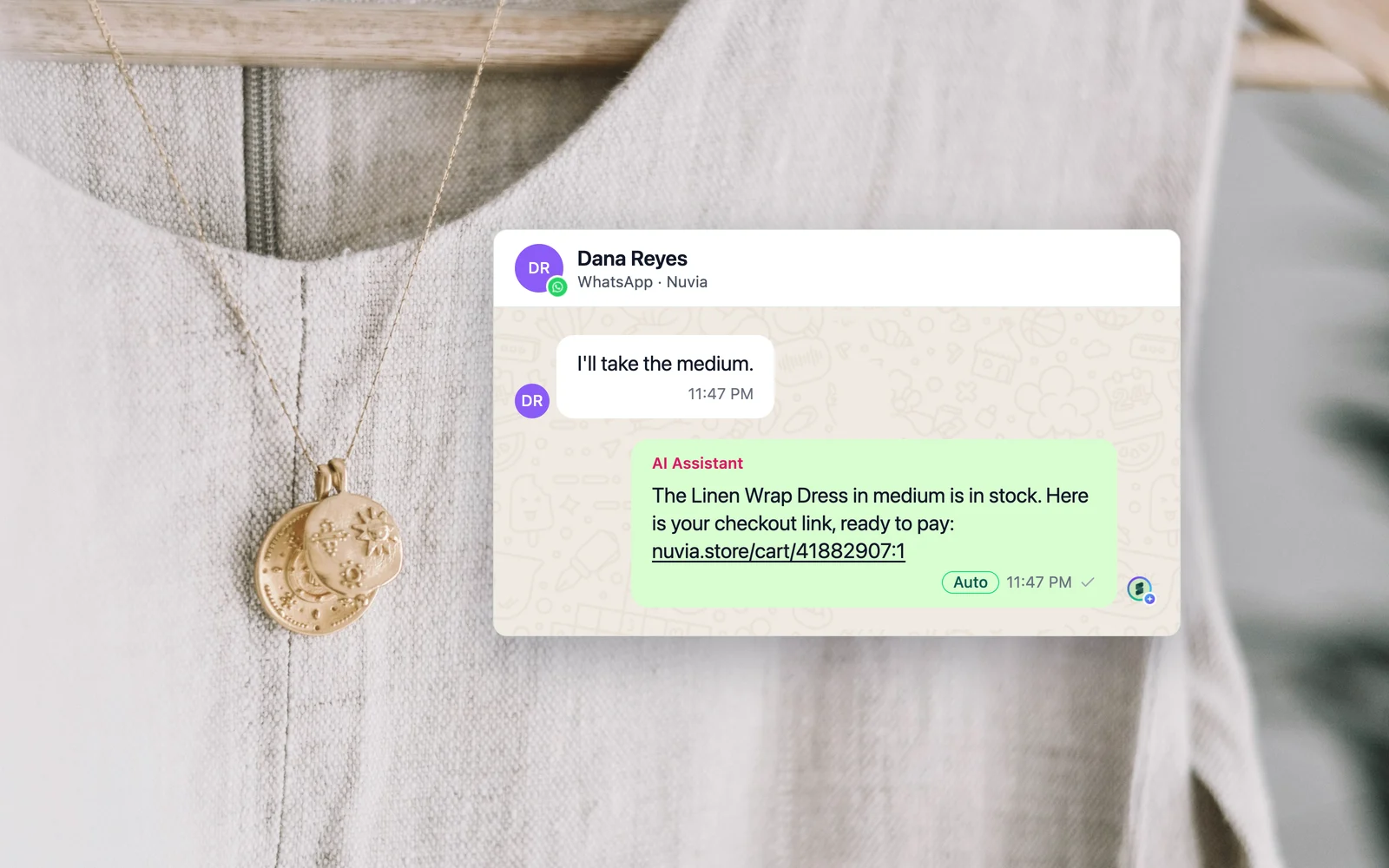
This is the part that separates an agent from an autoresponder. When a customer asks "do you have this in medium", the agent checks stock, confirms, and sends a checkout link for that variant. The customer pays in the browser the link opens, and the order lands in Shopify like any other.
For stores in markets where cash on delivery is normal, the agent confirms the address and phone number and creates the order in chat. If you sell in India or the Gulf, this turns WhatsApp into an order channel.
One men's grooming brand we run support for turns 1 in 13 chats into an order. How to work out your own rate has its own page. We put a guarantee behind this: "50 orders closed inside your DMs in 50 days, or you don't pay." The same mechanics work on Instagram DMs.
Will Meta restrict my number?
Meta restricts numbers that break its rules, and the rules are short enough to list. All of this comes from Meta's pages, read on 2026-11-17.
You need opt-in to start a conversation. The WhatsApp Business Messaging Policy says you may contact people who gave you their number and from whom you have "received opt-in permission". A bought list has none.
Replies live inside a 24-hour window, which opens and resets with each customer message. Inside it an AI agent replies freely. Outside it, you may only send approved message templates. A tracking answer and a checkout link are replies. A "your parcel has shipped" message two days later is a template.
Automation must offer a way to a person. The policy says you "must also have available prompt, clear, and direct escalation paths", and lists an in-chat transfer, a phone number, email and a support form among them. An agent that traps a customer in a loop breaks this rule.
Enforcement is a ladder: a warning, a 1 or 3 day block on templates, a 5, 7 or 30 day block on all messages, an account lock only an appeal can lift, then being disabled. Severe abuse such as scams skips the ladder.
Messaging limits count messages sent outside the window, starting at 250 customers in a moving 24 hours. Broadcasts hit them. An agent answering inside the window does not.
One clause to know: section 4.7 of Meta's platform terms bars AI providers when AI is the primary thing on offer, as Meta decides at its sole discretion, and Meta's note on it names general-purpose AI assistants, with effect from January 15, 2026. The same section says a business may retain an AI provider as its solution provider, as long as its WhatsApp data does not go into building or training AI models, apart from fine-tuning one for that business alone. We read a store's agent, answering about its own products and orders, as allowed. Meta has the final say.
When a WhatsApp app is enough
If your store gets a handful of WhatsApp chats a day and a person can reply within the hour, you do not need an agent. The WhatsApp Business app and that person will serve your customers well, and messages sent from the app stay free.
Meta also offers its own Meta Business Agent in the WhatsApp Business app, free up to a limit that refreshes, for select businesses in limited countries as of November 2026. Meta's pages for the app describe it answering from your catalog, website and past chats, and they do not list order lookups.
The math changes when questions arrive after everyone is asleep, because an unanswered 11:52 PM question is a sale waiting for whoever answers first. A store with its own support team fits as well: the agent takes the repeat questions, and your team works alongside it in the helpdesk built in.
A WhatsApp AI agent for Shopify runs on Meta's Business Platform, answers from your catalog and orders, and sends a checkout link in the thread. Budget for Meta's per-message fees, a provider and AI usage, and keep a clear route to a person.
Common questions
What is a WhatsApp chatbot?
A WhatsApp chatbot is software that replies to customers on a business WhatsApp number automatically. The older kind follows a fixed menu of buttons. The current kind, usually called an AI agent, reads free text, voice notes and photos, pulls product and order data from the store, and writes its own replies on Meta's WhatsApp Business Platform.
Do I need the WhatsApp Business API?
Yes, if you want an agent connected to your store answering customers. The WhatsApp Business Platform, which is the API, is the route for that. A personal number has no API. As of November 2026, a number on the WhatsApp Business app can connect to the API and stay on the app, with limits Meta lists, and Meta bills API messages per delivery.
Will Meta ban my number for automating replies?
Not for answering customers who messaged you first. The WhatsApp Business Messaging Policy, read on 2026-11-17, allows automated replies inside the 24-hour customer service window as long as the customer has a prompt, clear path to a person. Outside that window you may only send approved message templates. Enforcement starts with a warning, then temporary blocks, and reaches a ban after repeated violations or severe abuse.