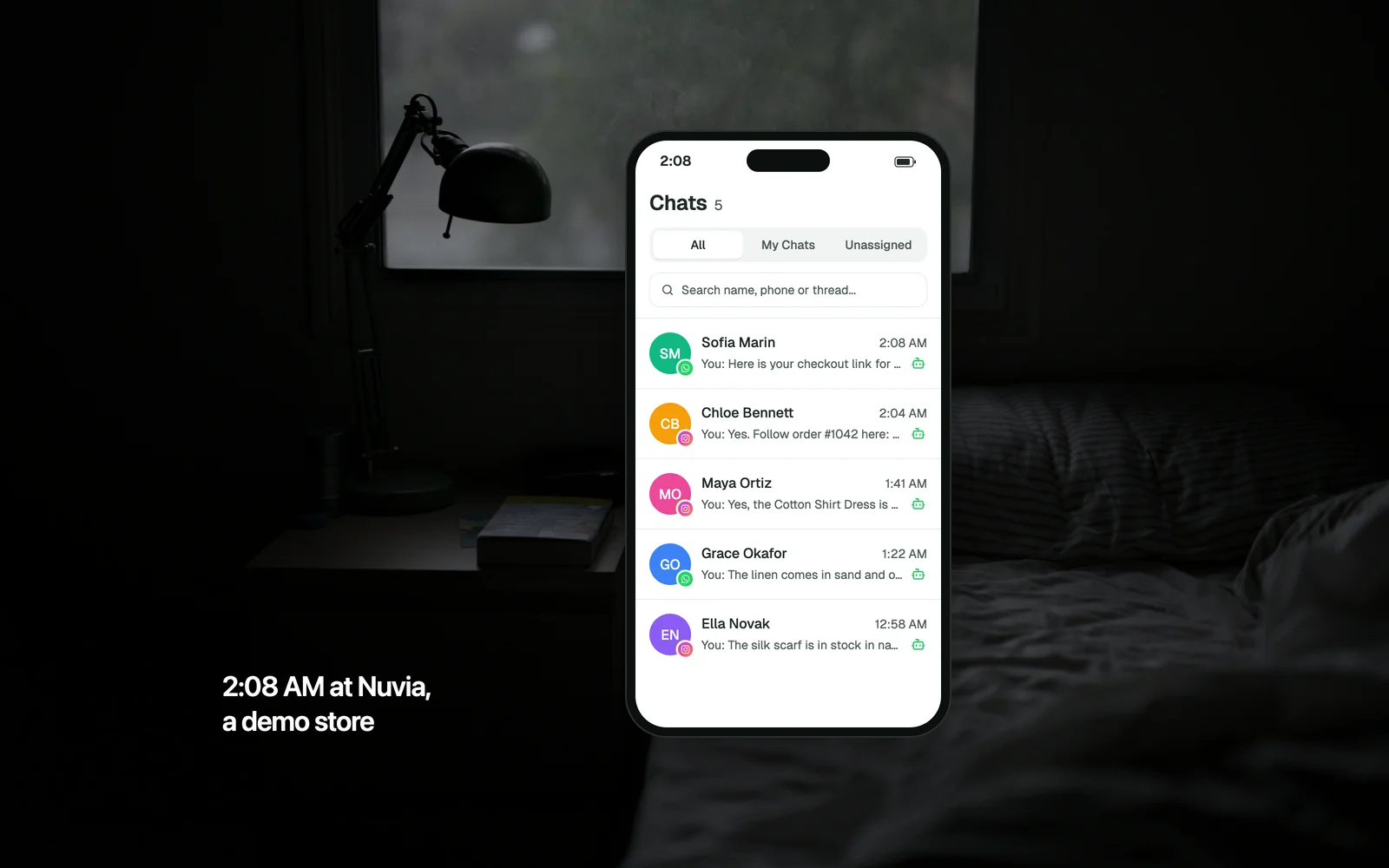
After-hours customer support for an ecommerce store means every message that arrives while nobody is staffed gets an accurate answer, and anything that needs a person is waiting in the inbox when you open. If your brand gets 50 or more conversations a day, the option that fits is an AI agent that answers overnight and hands the rest to your team in the morning.
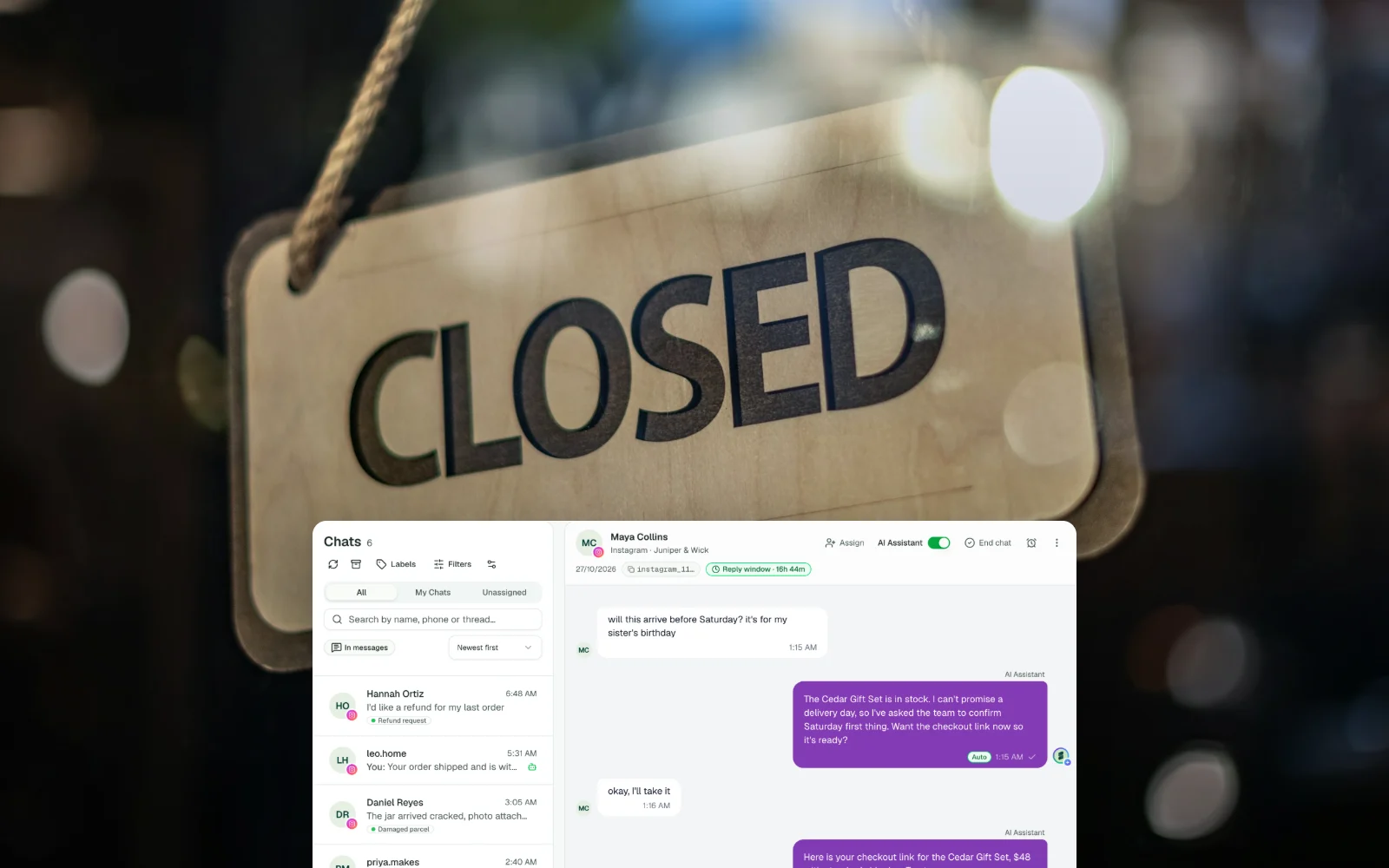
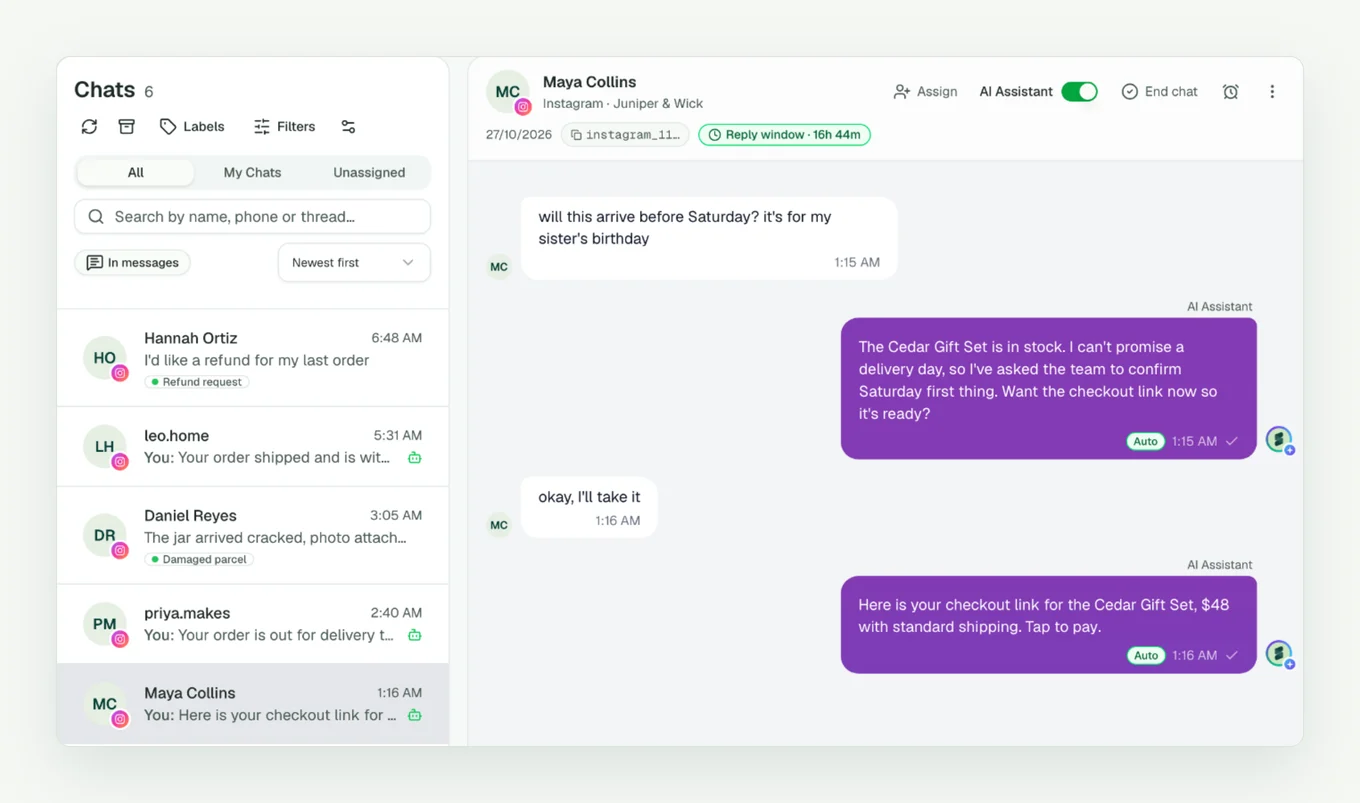
Here is the message that decides it, on a demo store. Juniper & Wick sells candles, and its founder closes the laptop at 7 PM. At 1:15 AM a customer three time zones away sends an Instagram DM: a photo of the cedar gift set and "will this arrive before Saturday? it's for my sister's birthday." She has her card out and two other tabs open.
The founder answers only if they are awake. A VA on a night shift answers if they know the shipping cutoffs. An auto-responder says "we'll get back to you within 24 hours," and she buys from the second tab. An AI agent replies within seconds with what the store's shipping options and cutoffs say, offers a checkout link, and leaves anything it should not promise for the team at 9 AM.
Key facts
- Meta's standard messaging window for Instagram and Messenger lasts 24 hours for most customer actions (Meta Messenger Platform and IG Messaging API policy, read 2026-11-23).
- Meta's Human Agent tag lets a business reply manually inside a separate 7-day period (same Meta policy page, read 2026-11-23).
- Order tracking is roughly half of all customer queries across the stores Support Fabric runs (Support Fabric data, October 2026).
- Support Fabric's AI agent replies 24/7, usually within seconds, and answers product questions in under 30 seconds (November 2026).
- Support Fabric passes AI usage through at cost, and a conversation costs 2 to 4 cents in AI usage (November 2026); the plan is on the pricing page.
Count your overnight messages first
This takes about 10 minutes, and your count is the only number that should decide this.
- Pull the last 7 days of messages from every inbox you answer: Instagram DMs, WhatsApp, Messenger, website chat and email.
- Count the ones that arrived outside your staffed hours, including weekends if nobody works them.
- Of those, count how many were order status, product questions or buying questions ("do you have this", "which size", "will it arrive by").
- Of the ones you answered the next morning, count how many never wrote back.
Step 4 is the uncomfortable one: people who asked, waited and left. Then add your daytime volume and divide by 7 for conversations a day. Keep both numbers.
Tonight, after you close, send your own store a DM from a personal account: "do you have this in a gift set, and can I still order for this weekend?" Note what comes back, and when.
The four options, one by one
Option 1: you, on your phone at night
Most founders start here. Under 50 conversations a day, this is probably fine. You know the product better than anyone, you can take the order yourself, and the cash cost is zero.
The cost is you. You answer the 1:15 AM DM only if you are awake, half asleep, often without the order in front of you. And you never switch off, because the phone is on the nightstand.
What it misses: everything that arrives while you sleep. Your step 2 count is the size of that pile.
Option 2: a virtual assistant or an offshore shift
This is a person in another time zone whose working day is your night. A good one handles the judgment calls: the angry customer, the refund dispute, the odd request.
I will not quote an hourly rate, because rates vary by country, agency and experience; get real quotes. Then add what never appears on the quote. You pay for the whole shift, quiet hours included. One person covers one shift, so weekends and holidays mean a second hire or gaps. Someone teaches them your products, sizing, shipping cutoffs and tone, and again at every launch. Someone briefs the night shift every evening and reads its notes every morning. And they need your inbox logins.
What it misses: anything outside their shift or their training. The gift question gets a good answer if the VA knows the Saturday cutoff, and "let me check with the team" if they do not.
Option 3: an auto-responder
The cheapest option on paper, and in my view the worst one for a store that sells in DMs.
It does one thing well: it sets expectations. A customer who reads "we reply between 9 AM and 7 PM Eastern" knows she has not been ignored. For a complaint or a return, that is enough.
What it cannot do is answer the question. The gift buyer asked about Saturday, and the auto-reply answers with your opening hours. It tells a buying customer to wait at the moment she is deciding whether to buy.
What it misses: every question, and every sale that needed an answer.
Option 4: an AI agent with a morning handoff
This is an AI agent connected to your store, trained on your products and policies, working the same inbox your team opens in the morning.
Support Fabric is a done-for-you AI customer support service for Shopify and WooCommerce brands. It deploys a custom AI agent across WhatsApp, Instagram DMs, Messenger, website chat and email that answers customers in seconds, tracks orders, recommends products and closes sales in chat, with a 48-hour go-live.
Our agent replies 24/7, usually within seconds. Product questions (sizes, fit, ingredients, availability, recommendations) get an answer in under 30 seconds. Where is my order, roughly half of all queries across our stores, is answered from the order record in the same thread, with the courier, tracking details and status. It understands voice notes, and photos: the picture of the cedar gift set comes back as that product. When she says "okay, I'll take it," it drops a ready-to-pay checkout link in the chat, and stores that take cash on delivery can have the order placed in the conversation.
What it misses: the judgment calls, by design. A damaged parcel, a refund dispute, a promise you would rather make yourself: those wait for your team.
What your team sees at 9 AM
Your team opens the helpdesk built into Support Fabric, where the overnight order and product questions are already answered, some with orders attached. The few threads that need a person are labeled and noted, with the customer's photo or voice note still in the thread. The first thing anyone works on is the refund dispute.
Which option fits your store
- Under 50 conversations a day and a small step 2 count: option 1 wins on cost. Answer from your phone and add an auto-reply for complaints and returns, so nobody feels ignored.
- You need a person for judgment calls overnight: option 2, priced on real quotes with every line above added in.
- Most of your overnight pile is order status, product and buying questions: option 4. Compare its cost with option 2 on your own quotes and your own count.
To put a dollar figure on the overnight pile: one grooming brand we run support for turns 1 in 13 chats into an order. Multiply your step 3 count by that rate and your average order value for a rough weekly number. Peak season makes the nights longer, and the Black Friday support plan covers those weeks.
My view, as the person who built this: a small team can cover 9 to 7. Nobody covers 1:15 AM without paying in money or sleep, and the messages that arrive then are often the ones with the card out. That is why our agent does the full job at night, answer and sell, and leaves the morning team only the work that needs a person. The Support Fabric overview has the rest.
A note on Meta's reply windows
If you answer Instagram DMs or Messenger, Meta's Messenger Platform and IG Messaging API policy, read on 2026-11-23, says the standard messaging window lasts 24 hours for most user actions. A separate Human Agent tag lets a business reply manually inside a 7-day period.
A 9 AM reply to a 1:15 AM message sits inside the 24 hours. A Friday night message answered on Monday does not, and needs the Human Agent tag. The same page says that where the law requires it, automated chat must tell people they are talking to an automated service; check that whatever you pick does.
Count a week of overnight messages first. Under 50 conversations a day, your phone and an auto-reply will do. Above that, if most of the pile is order and buying questions, an AI agent covers the night and leaves the judgment calls for the morning.
Common questions
How do small ecommerce stores handle customer support after hours?
Most use one of four options: the founder answers from a phone at night, a virtual assistant or offshore shift covers the hours, an auto-responder sets expectations, or an AI agent answers overnight and hands the rest to the team in the morning. Under about 50 conversations a day, answering from your phone is usually fine. Above that, count a week of overnight messages and compare a VA's quoted cost against an AI agent's.
Is an auto-reply enough for after-hours messages?
For complaints and returns, an auto-reply that states your hours is enough, because it tells the customer they have not been ignored. For order status, product and buying questions, it falls short: it tells the customer to wait at the moment they are deciding whether to buy.
What happens to after-hours messages the AI agent cannot answer?
With Support Fabric, after-hours messages the AI agent cannot answer wait in the helpdesk your team uses, with conversation labels and notes, so the morning team sees what needs a person and why. The customer's full thread, including any photo or voice note, stays attached, and your team can assign it, add notes and reply in that thread.