Most messages a skincare brand gets in Instagram DMs and WhatsApp are product-fit and order questions, and an AI agent can answer them from your own catalog and ingredient lists in seconds. Reactions, allergies, pregnancy and anything medical go to a person every time, from the first message. Good customer service for skincare brands comes down to drawing that line clearly and then letting the software work on the right side of it.
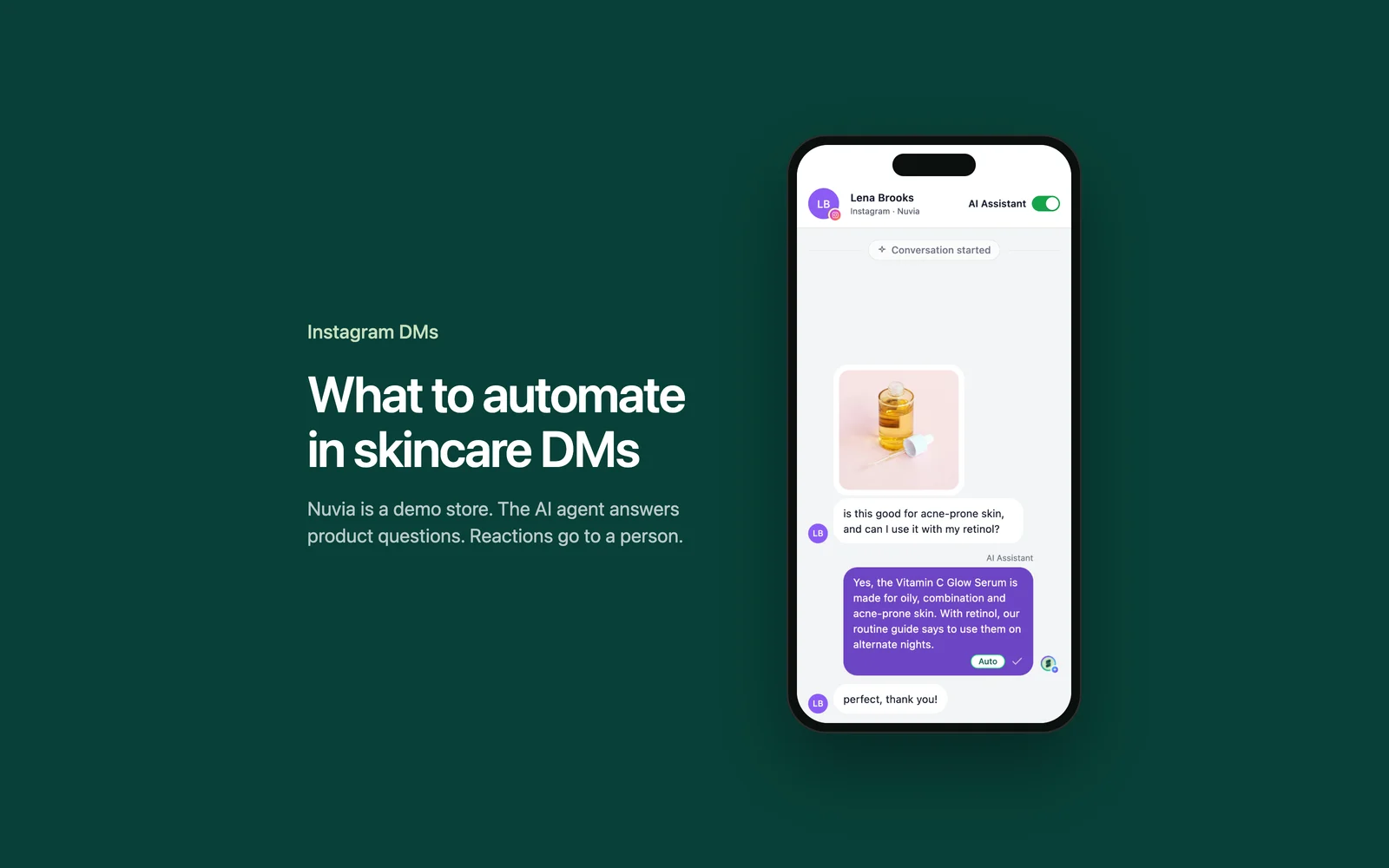
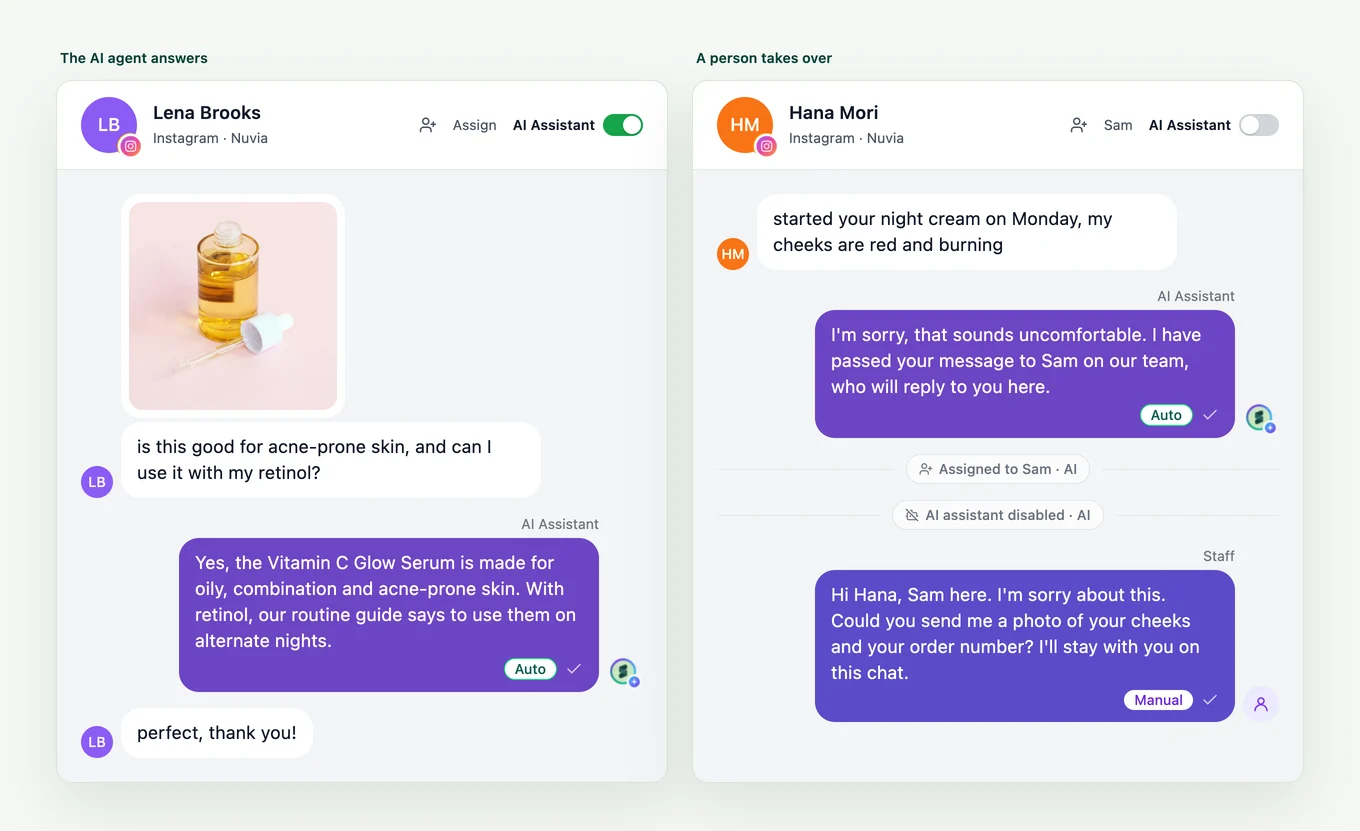
A made-up example from Nuvia, a demo store: A little after 1 AM a customer sends a photo of the vitamin C serum and writes: "is this good for acne-prone skin, and can I use it with my retinol?" Twenty minutes later a different customer writes: "started your night cream on Monday, my cheeks are red and burning." The first is a catalog question, answered by the product page and routine notes you already wrote. The second is a health complaint, and no software should decide what that customer does next. Most guides on this topic say reactions go to a human. Very few say how, so that is most of this post.
What skincare customers ask in DMs
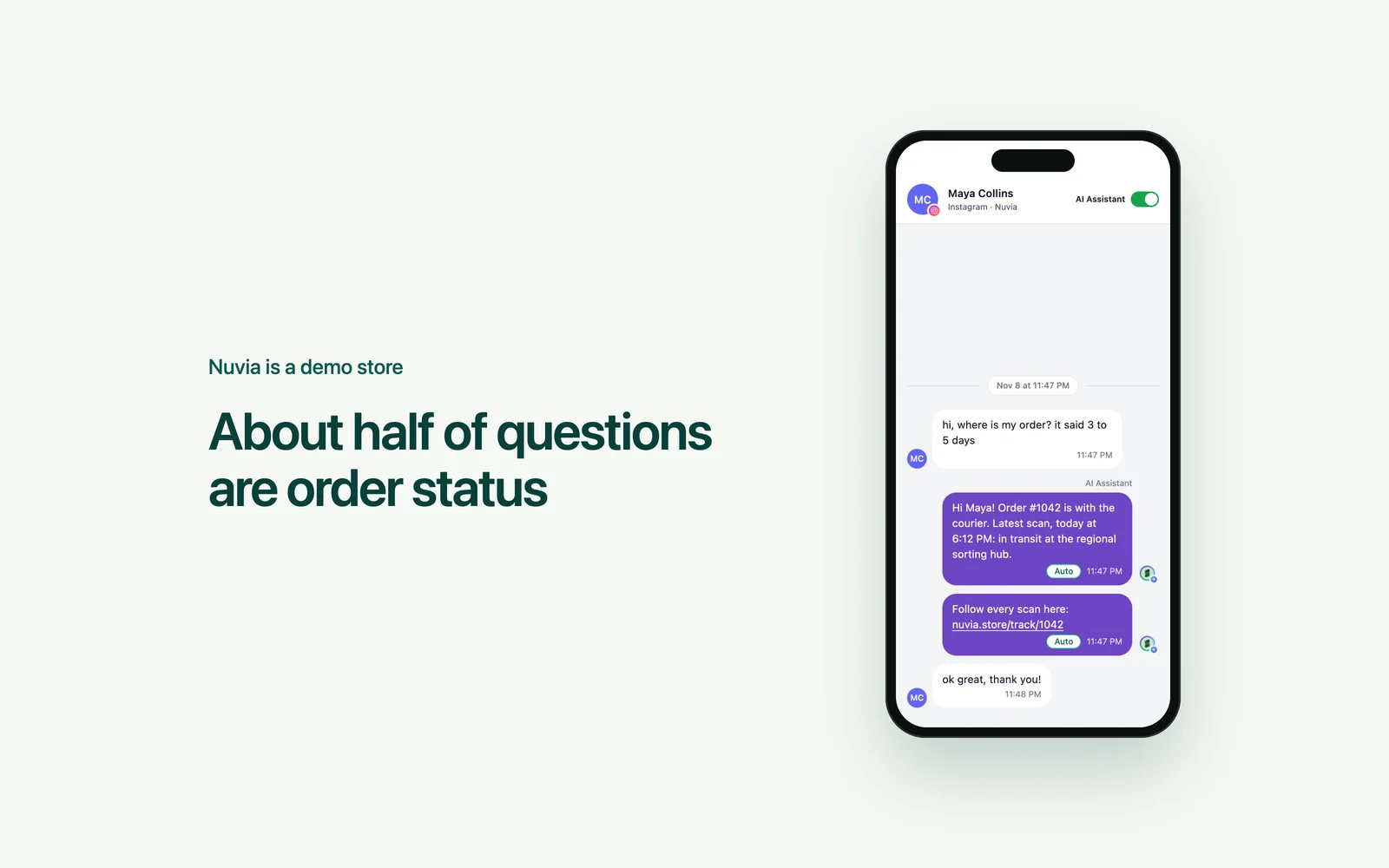
Across the stores we run support for, order tracking is roughly half of all customer questions. In a skincare store that sounds like: where is my parcel, why has the tracking not moved, can I change the address. We wrote a whole post on the where is my order question because it eats more inbox time than anything else.
The other half is where skincare differs from fashion or electronics. The questions lean hard into fit and ingredients:
- Which product suits my skin type (oily, dry, sensitive, acne-prone)
- Can I use this with retinol, vitamin C, AHAs or another product I already own
- What order do I put these on, morning and night
- Is this shade right for me, or is it back in stock
- Is this original, and where do you ship from
- A photo of a product with "do you sell this?" or "which one is this?"
A small number of messages sit in a third group: a rash, swelling, burning, a breakout after starting something new, a question about using a product while pregnant or on prescription medication. They are rare, and they are the ones that end up in a screenshot on someone's Instagram story after the wrong reply.
What an AI agent should answer
Anything your own product data already answers is safe ground for an AI agent, as long as it answers from that data and nothing else. That means:
- Product fit from your catalog. Listed skin types, key ingredients, sizes.
- Routine order and pairing, from your own notes. If your brand page says "use on alternate nights to retinol", the agent can repeat that. If your page says nothing, the agent should say so and offer a person.
- Stock, shades and restocks. Live availability from the store.
- Photo to product. A screenshot from a creator's video, matched to the product in your store.
- Voice notes. Plenty of DM customers would rather talk than type.
- Order status. Tracking, delays and delivery questions, from the order itself.
- The sale. A checkout link in the chat once the customer picks, so a 1 AM decision becomes a 1 AM order.
The test: could a new hire give this answer by reading your product pages and policies? If yes, automate it. If it needs judgment about someone's skin, it belongs to the next group.
There is a regulatory reason to keep the agent inside your catalog too. The US FDA says whether a product is regulated as a cosmetic or a drug depends on its intended use, and that intended use can be established by claims in advertising, "on the Internet, or in other promotional materials" (FDA, content current as of September 11, 2024). The same page gives cleansers intended to treat acne as an example of a product regulated as a drug. A chat reply is part of how you talk about your products, so keep the agent repeating what you have already published.
What goes to a person, every time
Reactions, allergies, pregnancy, breastfeeding, prescription medication, and any message that reads like a health complaint. The AI agent should never diagnose a reaction, tell someone a product is safe for a condition, or suggest they keep using it.
Here is the handoff rule I would give any skincare brand, on any tool:
- Write the trigger list yourself. Rash, red, burning, itching, swelling, hives, breakout after starting, allergic, pregnant, breastfeeding, prescription, doctor, dermatologist. Add the words your own customers use.
- Script the first reply. Something like: "I'm sorry this happened. A member of our team will take over this chat and reply to you personally." No product advice, no "this is normal", no "try using it less often".
- Assign the chat to a named person and turn the AI off for that chat. From that point a human owns the conversation until it closes.
- Decide who and when. One person owns reaction messages, with a backup for nights and weekends. Write down how quickly they reply, and keep to it.
- Log it. Add a label and a note with the product, batch if the customer has it, and what you told them.
Complaints and damaged parcels sit in between: the agent says sorry, collects the order number and a photo, then hands the chat over.
In Support Fabric, this is how the inbox already works: your team sits in the same inbox as the AI agent, a chat can be assigned to a person, AI can be switched off for that one chat, and labels, internal notes and tickets keep the record. We set the agent up from your instructions, so the topics it must never answer go into those instructions on the onboarding call. It is an instruction the agent follows, so the first-week check below still matters.
What good looks like in numbers
When the product questions get answered properly, skincare chats turn into sales. Mazton Skin Solutions, a skincare brand we run support for, went 6x: chat conversion moved from 2% to 12%. The details are on our case studies page.
Outside skincare, a men's grooming brand we work with turns 1 in 13 chats into an order. We broke down what drives that rate in our post on AI chat conversion.
Setting it up without a support team
You do not need a support team to run this, but you do need to hand over four things:
- Your full catalog, with ingredient lists and the skin types each product is for
- Your routine and pairing notes, in your own words
- Your shipping, returns and damaged-parcel policy
- The list of questions the AI agent must never answer, plus the trigger words from the section above
Then check the first week by hand. Read every chat the agent answered about ingredients and compare it with your product pages. Send a test message from a personal account with "my skin is burning after your serum" and confirm it reaches a person with the AI off. Search the inbox for your trigger words, confirm every match was handed over, and add any phrasing you missed.
If you would rather not build this yourself, done-for-you services exist, and Support Fabric is one. Support Fabric is a done-for-you AI customer support service for Shopify and WooCommerce brands. It deploys a custom AI agent across WhatsApp, Instagram DMs, Messenger, website chat and email that answers customers in seconds, tracks orders, recommends products and closes sales in chat, with a 48-hour go-live. Skincare and beauty brands such as Mazton Skin Solutions and Mana Beauty run on it, with the helpdesk included for everything the agent hands over. You can see the steps on how it works.
Common questions
Can an AI agent give skincare advice? It can give product information from your own catalog: which skin types a product is listed for, its ingredients, how your brand says to use it, and whether it is in stock. It should never give medical or dermatological advice, judge a reaction, or say a product is safe during pregnancy or alongside a prescription. Those questions go to a person on your team, every time, from the first message.
What should a skincare brand never automate? Replies to reactions, allergies, pregnancy and breastfeeding questions, prescription medication questions, and anything that reads like a health complaint. The AI agent's only job there is a short, scripted message saying a person will take over, followed by assigning the chat to that person and switching the AI off for it. Everything after that is human, and the conversation gets a label and a note.
Can one AI agent handle Instagram DMs and WhatsApp for a skincare brand? Yes, if the tool puts every channel in one inbox. Your team needs every conversation in one place to pick up handoffs. Support Fabric covers WhatsApp, Instagram DMs, Messenger, website chat and email in one inbox, with your team working alongside the AI agent.
A skincare brand should let an AI agent answer what its product pages already answer: fit, ingredients, routine, stock, shade and order status, with a checkout link when the customer is ready. Hand reactions, allergies, pregnancy and medical questions to a named person from the first message, with the AI off for that chat. Write the trigger list yourself and test it in week one.